
Dumpster rental works best when it’s planned—not improvised. Too often, containers are ordered without fully considering project scope, debris type, or timing, which leads to avoidable delays and added costs. Drawing on Jiffy Junk’s real-world experience coordinating dumpster rentals for everything from small home projects to large commercial jobs, we’ve seen that the most successful rentals are mapped out well before delivery day.
This article is built around a practical dumpster rental checklist designed to help you prepare before your project begins. You’ll learn how to evaluate your cleanup needs, select the right dumpster size, confirm delivery and pickup details, understand material restrictions, and avoid common mistakes that drive up dumpster rental costs. With the right preparation, dumpster rental becomes a reliable tool that keeps your project organized, efficient, and on budget from start to finish.
Quick Answers
Dumpster Rental
Dumpster rental is a temporary waste solution used for cleanouts, renovations, and construction projects where large volumes of debris need to be removed efficiently. From hands-on experience, the most successful dumpster rentals are planned around project volume, timing, and material type not just price and aligned with services such as top duct cleaning to keep worksites efficient and compliant.
Choose a dumpster based on how much space debris will take up
Schedule delivery close to project start to avoid idle days
Confirm restricted materials before loading
Clear pricing prevents overage and extension fees
Top Takeaways
- Preparation reduces costs.Most dumpster issues come from missing details.
- Size selection is critical.Undersizing leads to overflow and repeat rentals.
- Timing impacts pricing.Idle days and extensions increase costs.
- Material rules matter.Restricted items cause delays and extra fees.
- Checklists prevent surprises.Clear planning keeps projects moving.
Why a Dumpster Rental Checklist Matters
Dumpster rental pricing and logistics are straightforward—when planned correctly. Problems arise when dumpsters are ordered without accounting for debris volume, project duration, site access, or disposal restrictions. A checklist ensures these details are addressed before booking, not after problems appear.
For both homeowners and contractors, this planning step often determines whether a project stays on schedule.
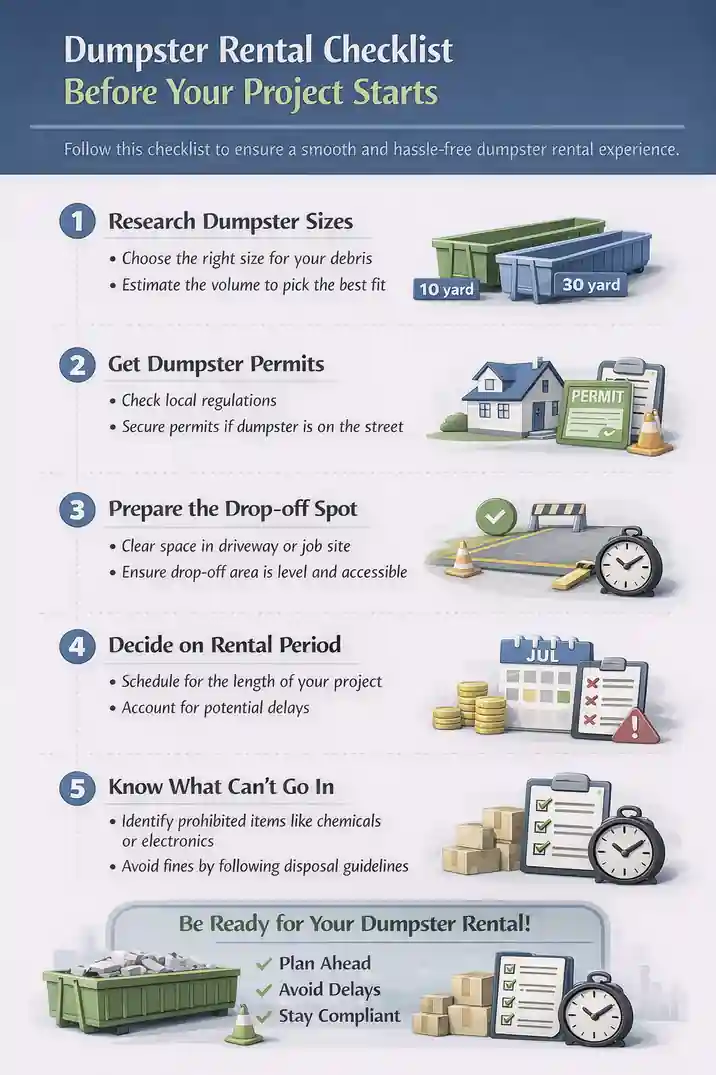
Dumpster Rental Checklist
“From coordinating thousands of real-world dumpster rentals, one lesson stands out: most problems don’t happen on pickup day—they happen before the dumpster ever arrives. When project scope, volume, timing, and material rules are planned in advance, dumpster rentals stay predictable, efficient, and cost-controlled, especially when paired with related site services such as dryer vent cleaning. That kind of reliability only comes from experience.”
Essential Resources
Using trusted resources helps confirm details before booking a dumpster rental.
Dumpster Size Guide – Budget Dumpster
Learn how dumpster sizes compare and which projects they fit best.
https://www.budgetdumpster.com/resources/dumpster-sizes/
https://www.budgetdumpster.com/resources/dumpster-sizes/
Waste Disposal Basics – EPA
Understand proper disposal and recycling requirements.
https://www.epa.gov/recycle
https://www.epa.gov/recycle
Construction & Demolition Materials – EPA
Learn how mixed debris is handled at disposal facilities.
https://www.epa.gov/smm/sustainable-management-construction-and-demolition-materials
https://www.epa.gov/smm/sustainable-management-construction-and-demolition-materials
Permit Requirements – Local Municipal Guidance
Check local rules for street placement and permits.
https://www.usa.gov/local-governments
https://www.usa.gov/local-governments
Household Hazardous Waste – EPA
Identify materials that cannot go in dumpsters.
https://www.epa.gov/hw/household-hazardous-waste-hhw
https://www.epa.gov/hw/household-hazardous-waste-hhw
Appliance Disposal Guidance – Energy Star
Understand appliance disposal rules.
https://www.energystar.gov/products/recycling_guidance
https://www.energystar.gov/products/recycling_guidance
Project Cleanup Planning – OSHA
Review site safety and cleanup planning considerations.
https://www.osha.gov/laws-regs/regulations/standardnumber/1926
These trusted resources help confirm dumpster sizing, disposal rules, permits, and safety requirements before booking, ensuring cleanup runs smoothly while related site considerations such as duct cleaning are accounted for during overall project planning.
https://www.osha.gov/laws-regs/regulations/standardnumber/1926
Supporting Statistics
Dumpster rental planning is supported by national waste data.
EPA data shows millions of tons of bulky household and construction debris enter landfills annually
https://www.epa.gov/facts-and-figures-about-materials-waste-and-recycling
Landfill tipping fees vary widely by region, directly impacting dumpster rental pricing
https://erefdn.org/analyzing-municipal-solid-waste-landfill-tipping-fees/
Short-term projects generate concentrated waste volumes, increasing the need for temporary dumpsters
https://www.epa.gov/smm/sustainable-materials-management
Bottom line: projects that plan dumpster rental upfront experience fewer delays, fewer overages, and more predictable costs.
EPA data shows millions of tons of bulky household and construction debris enter landfills annually
https://www.epa.gov/facts-and-figures-about-materials-waste-and-recycling
Landfill tipping fees vary widely by region, directly impacting dumpster rental pricing
https://erefdn.org/analyzing-municipal-solid-waste-landfill-tipping-fees/
Short-term projects generate concentrated waste volumes, increasing the need for temporary dumpsters
https://www.epa.gov/smm/sustainable-materials-management
Final Thought & Opinion
Dumpster rental works best when it’s planned as part of the project—not handled at the last minute. In real-world projects, most dumpster-related problems don’t come from the cleanup itself, but from small details that were overlooked before booking.
Common issues we consistently see include:
Choosing a dumpster size based on guesswork instead of project volume
Scheduling delivery too early or pickup too late, leading to idle days or extension fees
Failing to confirm material restrictions, resulting in rejected loads or added charges
Not planning site access, which can delay delivery or require relocation
A simple checklist changes dumpster rental from reactive to proactive. When you confirm size, timing, placement, and disposal rules upfront, dumpsters become:
More cost-predictable
Easier to load efficiently
Less likely to require repeat rentals
A dependable part of keeping projects on schedule
Our opinion:
Dumpster rental shouldn’t create friction in your project. With proper planning and a clear checklist, it becomes a reliable tool that supports efficiency, controls costs, and eliminates unnecessary stress from start to finish.
Choosing a dumpster size based on guesswork instead of project volume
Scheduling delivery too early or pickup too late, leading to idle days or extension fees
Failing to confirm material restrictions, resulting in rejected loads or added charges
Not planning site access, which can delay delivery or require relocation
More cost-predictable
Easier to load efficiently
Less likely to require repeat rentals
A dependable part of keeping projects on schedule
FAQ on Dumpster Rental
Q: Why use a dumpster rental checklist?
A: A checklist prevents sizing mistakes, scheduling issues, and unexpected fees before they occur.
Q: What’s the most common dumpster rental mistake?
A: Choosing a dumpster that’s too small for the project volume.
Q: Does the loading method really matter?
A: Yes. Poor loading wastes space and causes overflow issues.
Q: When should I schedule dumpster delivery?
A: As close to project start as possible to avoid idle days.
Q: Are all materials allowed in dumpsters?
A: No. Always confirm restricted items with your provider.
A: A checklist prevents sizing mistakes, scheduling issues, and unexpected fees before they occur.
A: Choosing a dumpster that’s too small for the project volume.
A: Yes. Poor loading wastes space and causes overflow issues.
A: As close to project start as possible to avoid idle days.
A: No. Always confirm restricted items with your provider.