At Jiffy Junk, we’ve seen firsthand that dumpster pricing isn’t “one-size-fits-all.” It’s usually driven by how much space your debris takes up, how heavy it is, and local disposal rules—which is why quotes can vary so widely.
This guide breaks down real-world dumpster rental prices ranges for small projects, what’s typically included, and the common fees that catch people off guard—so you can plan your budget with confidence.
TL;DR Quick Answers
Dumpster rental prices
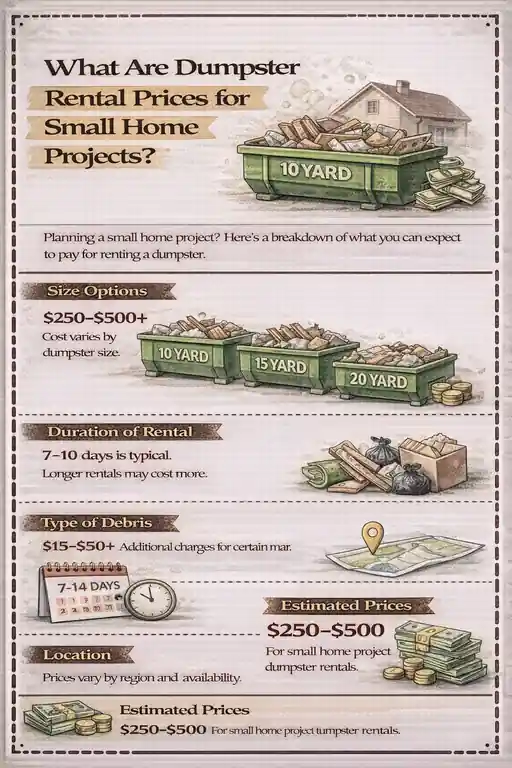
Dumpster rental prices for small home projects typically range from $250–$600, depending on dumpster size, debris weight, rental length, and local disposal fees.
At Jiffy Junk, we’ve found the biggest cost surprises usually come from weight limits—especially with heavy debris like tile, drywall, flooring, and plaster. To avoid overpaying, always confirm the included tonnage and what fees apply if you go over.
Top Takeaways
Small project dumpster rentals usually cost $250–$600.
Weight limits drive most surprise charges. Heavy debris adds up fast.
Confirm what’s included in the quote. Size, rental time, pickup/delivery, disposal, weight allowance.
Watch for hidden fees. Overages, extensions, prohibited items, permits, trip fees.
Choose the right option for your debris volume. Avoid paying for unused space or extra charges.
Dumpster Rental Prices for Small Home Projects
For most small home projects, dumpster rental prices typically range from $250 to $600, depending on your location, the dumpster size, the type of debris, and how long you keep the container. Smaller jobs—like a garage cleanout or yard cleanup—usually fall on the lower end, while renovation debris (especially heavy materials) can push costs higher.
At Jiffy Junk, we’ve seen that pricing surprises almost always come from two things homeowners don’t expect: weight limits and local disposal fees. That’s why getting the right size—and knowing what you’re tossing—matters more than chasing the lowest advertised price.
Typical Dumpster Rental Prices by Size
Most small home projects only need a 10-yard or 15-yard dumpster, but the “right” size depends on what you’re throwing away.
Here’s a realistic pricing snapshot:
10-yard dumpster: $250–$450
Best for small cleanouts, light renovation debris, yard waste15-yard dumpster: $300–$500
Great for medium cleanouts or small remodels20-yard dumpster: $350–$600
Common for larger cleanouts or renovation projects
Tip from experience: If your project includes bulky items (like furniture, cabinets, or drywall), you may need a larger dumpster even if the project itself feels “small.”
What Impacts Dumpster Rental Pricing the Most?
Dumpster pricing isn’t random — it’s based on real disposal and hauling costs. The biggest factors include:
Dumpster Size
Bigger dumpsters cost more because they take up more truck capacity and landfill space.
Weight Limits (One of the Biggest Price Drivers)
Most rentals include a weight allowance, and exceeding it can add overage charges. Heavy debris—like roofing shingles, concrete, tile, dirt, and plaster—adds weight fast.
Rental Period
Many rentals include a standard window (often 7–10 days). Keeping it longer may trigger daily extension fees.
Local Disposal Fees
Landfill and transfer station fees vary by region, and some areas charge more depending on the debris type.
What’s Usually Included in the Price?
A standard dumpster rental quote often includes:
Dumpster delivery and pickup
A set rental period (example: 7 days)
A weight allowance
Disposal fees (up to the included limit)
However, not every company structures pricing the same way — which is why comparing quotes can be tricky unless you know what to ask.
Common Extra Fees to Watch For
If you’re trying to keep costs low, these are the fees that most often surprise homeowners:
Overweight fees (going over the included tonnage)
Extended rental fees (keeping it longer than allowed)
Prohibited item fees (mattresses, tires, paint, batteries, chemicals)
Trip fees (blocked pickup access or overfilled dumpsters)
Permit fees (if placed on the street)
At Jiffy Junk, we always recommend asking for the quote in writing and confirming the weight limit before booking—especially for renovation debris.
How to Choose the Right Dumpster Size for a Small Project
If you’re unsure what to pick, use this quick rule:
Light debris (junk, clutter, yard waste): go smaller
Renovation debris (drywall, flooring, cabinets): size up
Heavy materials (tile, concrete, dirt): avoid overfilling and ask about weight limits
Choosing the right dumpster size is one of the easiest ways to avoid paying extra.
A Smart Alternative: Pay Only for the Space You Use
For many small home projects, a full dumpster rental isn’t always the best value—especially if you’re not filling it completely.
At Jiffy Junk, we often help homeowners with garage cleanout projects who only need partial-load disposal. Instead of paying for a full dumpster, you may be able to pay based on how much space your items take up, while still getting fast pickup and responsible disposal.
“One of the most common mistakes we see at Jiffy Junk is homeowners comparing dumpster quotes without checking what’s actually included. The price only makes sense when you know the rental period, weight allowance, and disposal fees—because that’s where the hidden costs usually live.”
Essential Resources
These resources help you dig deeper into dumpster pricing, sidestep hidden fees, and feel confident before you finalize your rental.
1) Dumpster Rental Cost Averages by State (Know What’s Normal Locally)
Before you book, compare your quote against real cost benchmarks in all 50 states — so you can tell if a price is fair or overpriced.
https://www.hometowndumpsterrental.com/blog/the-big-list-of-dumpster-rental-costs-in-all-50-states
2) Dumpster Rental Cost Breakdown (Understand What Drives Price)
Get a detailed look at how dumpster size, weight, rental period, and other factors affect the price — essential for realistic budgeting.
https://www.angi.com/articles/cost-dumpster-rental.htm
3) Dumpster Fees & Overage Guide (Avoid Surprise Charges)
Hidden fees like weight overages and delivery charges are where most customers get caught off guard. Use this guide to understand common extra costs so nothing sneaks up on you.
https://wastedoor.com/article/dumpster-rental-cost-guide
4) Dumpster Price Comparison Tool (Shop Smart With Multiple Quotes)
Compare providers and pricing side-by-side to find the best value for your project without endless phone calls.
https://www.dumpsterpricecheck.com/
5) National Dumpster Provider Pricing (Benchmark Against a Big Brand)
Seeing pricing from a major waste hauler helps you understand how local quotes stack up, so you can judge value with context.
https://www.wm.com/us/en/location/fl/miami/dumpster-rental-miami-fl
6) Real-World Pricing & Hidden Costs (What People Actually Pay)
This guide shows realistic price ranges by dumpster size and highlights the fees that often inflate your bill — perfect for checking assumptions before ordering.
https://dumpsterrentals.co/guides/dumpster-rental-cost-guide/
7) Dumpster Planning & Rental Resources (Choose the Right Size & Know Rules)
Estimate debris volume correctly, understand permit needs, and read up on local dumpster regulations to avoid delays and added charges.
https://www.dumpsters.com/resources
Supporting Statistics
At Jiffy Junk, we’ve learned firsthand that dumpster rental prices are mainly shaped by two real-world forces: how much waste is being generated and how expensive it is to dispose of it locally.
1) The U.S. generates a massive amount of waste
The U.S. produces 292.4 million tons of municipal solid waste (MSW) per year
That’s about 4.9 pounds per person per day
Why it matters: More waste = more demand on hauling and disposal systems, which can raise local pricing.
Source (EPA.gov): https://www.epa.gov/facts-and-figures-about-materials-waste-and-recycling/national-overview-facts-and-figures-materials
2) “Small home projects” often create heavy C&D debris
EPA estimates 600 million tons of construction & demolition (C&D) debris were generated in 2018
Why it matters: This is the type of debris that triggers weight-limit overages most often (tile, drywall, flooring, plaster).
Source (EPA.gov): https://www.epa.gov/facts-and-figures-about-materials-waste-and-recycling/construction-and-demolition-debris-material
3) Demolition waste dominates the category
Demolition accounts for 90%+ of total C&D debris generation
EPA reports just under 145 million tons of C&D debris were landfilled in 2018
Why it matters: Disposal rules and landfill charges vary by debris type, which impacts quotes.
Source (EPA.gov): https://www.epa.gov/smm/sustainable-management-construction-and-demolition-materials
4) Landfill disposal fees vary widely by region
Average landfill “tipping fee” in 2023: $56.80 per ton (U.S. national average)
Northeast average: $84.44 per ton
Why it matters: Higher tipping fees = higher dumpster rental costs and bigger penalties for overweight loads.
Source (EREFdn.org): https://erefdn.org/analyzing-municipal-solid-waste-landfill-tipping-fees/
Final Thought
Dumpster rental prices for small home projects often fall in the $250–$600 range—but the final cost depends on what your project really involves.
At Jiffy Junk, we’ve seen firsthand that pricing isn’t just about the dumpster size. It usually comes down to a few real-world factors that homeowners don’t always expect.
What typically drives the final price
Dumpster size
Debris weight (biggest surprise factor)
Rental time
Local disposal fees and rules
Our honest opinion
The biggest mistake we see is shopping dumpsters like they have a simple “price tag.”
A low quote can look great upfront—but if the weight allowance is low, it’s easy to get hit with extra fees.
This happens most often with “small” remodel projects involving heavy debris like:
Tile
Drywall
Flooring
Plaster
Fixtures
The smarter way to choose
In our view, when it comes to estate cleanout services, the best option isn’t always the cheapest dumpster—it’s the one that gives you the most clarity and control.
If you fill a container, a dumpster can be a great value.
If you won’t use the full space, paying for only what you use may be the better deal.
Bottom line: The goal isn’t just renting a dumpster—it’s getting rid of the mess without surprise charges.
FAQ on Dumpster Rental Prices
Q: What do dumpster rentals cost for small home projects?
A: Most small projects cost $250–$600. Pricing depends on:
Dumpster size
Debris weight
Local disposal fees
Rental length
Q: What dumpster size do I need for a small cleanout or renovation?
A: Most small projects use:
10-yard (light cleanouts)
15-yard (medium cleanouts)
20-yard (bulky or renovation debris)
At Jiffy Junk, we often see people need a bigger size once debris is broken down and takes up more space.
Q: Why do dumpster rental quotes vary so much?
A: The difference is usually in what’s included, such as:
Weight allowance
Rental period
Disposal fees
Delivery/pickup terms
Low quotes can jump if weight limits are too low.
Q: What extra fees should I watch for?
A: Common surprise charges include:
Overweight fees
Extra-day rental fees
Restricted item fees (tires, paint, batteries, chemicals)
Permit fees (street placement)
Q: Is a dumpster always cheaper than junk removal?
A: Not always. From our experience at Jiffy Junk:
Dumpster = best if you’ll fill most of it
Junk removal = better if you only have a partial load and want to avoid paying for unused space or overages