From first-hand experience helping families navigate estate cleanouts for the first time, the biggest struggle isn’t physical effort—it’s knowing where to begin, what to protect, and what mistakes can’t be undone once items are removed. This beginner-friendly guide breaks the estate cleanout process into clear, manageable steps so you can move forward with confidence, structure, and peace of mind from day one.
Quick Answers
estate cleanout
An estate cleanout is the structured process of sorting, protecting, and clearing a home’s contents after a major life transition, such as a death, downsizing, or property sale.
In practice, it involves more than removal:
Identifying and securing documents, valuables, and heirlooms first
Sorting belongings into keep, donate, sell, recycle, or dispose categories
Coordinating responsible donation and disposal
Preparing the property for sale, transfer, or move-out
Key insight:
From real-world experience, successful estate cleanouts aren’t defined by speed—they’re defined by order and decision clarity, which prevents costly mistakes and irreversible loss.
Top Takeaways
Estate cleanouts require decisions, not just removal
Beginners often underestimate the planning involved.Most people face estate cleanouts unexpectedly
A checklist provides direction when emotions are high.Order matters more than effort
Starting in the wrong place leads to costly mistakes.Professional help is optional—but strategic
Especially helpful for large or time-sensitive cleanouts.A checklist reduces overwhelm
Clear steps turn a daunting task into manageable actions.
What Is an Estate Cleanout Checklist?
An estate cleanout checklist is a structured guide that walks beginners through the process of clearing a home after a major life event. Unlike basic junk removal, an estate cleanout checklist focuses on decision-making—what to keep, what to protect, what to donate, and what can be responsibly removed.
For beginners, the checklist serves as both a planning tool and a safeguard. It helps ensure important documents, valuables, and sentimental items are identified before anything leaves the property, which is especially important if future plans include a kitchen remodel or other property updates. Executors, family members, and first-time estate managers often rely on checklists to avoid missed steps and unnecessary regret.
When Do Beginners Need an Estate Cleanout Checklist?
Most first-time estate cleanouts happen during periods of transition, including:
After the loss of a loved one
Before selling or listing a property
During downsizing or relocation
When settling an estate through probate
When facing deadlines or unsafe living conditions
In beginner situations, emotional stress, legal responsibility, and time pressure often overlap. A checklist provides clarity when decisions feel overwhelming and keeps the process moving forward methodically.
How the Estate Cleanout Checklist Process Works
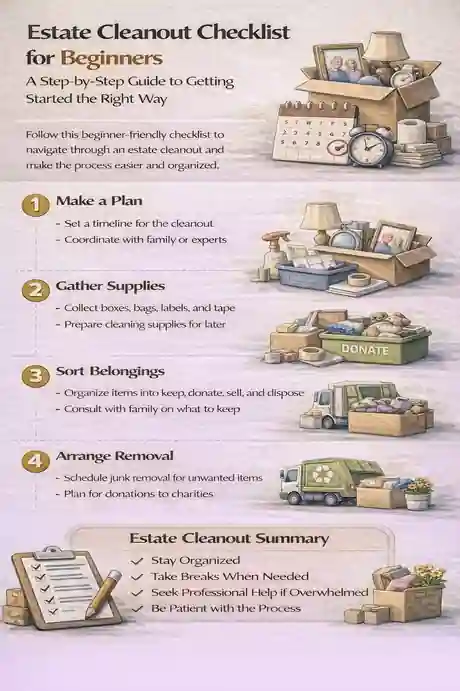
While no two cleanouts are identical, beginner-friendly estate cleanout checklists typically follow a proven sequence:
Initial assessment
Walk through the home to understand volume, layout, and urgency before removing anything.Protect critical items
Secure documents, heirlooms, valuables, and digital records immediately.Sort belongings intentionally
Group items into keep, donate, sell, recycle, or dispose categories.Coordinate removal responsibly
Arrange donation drop-offs, recycling, and disposal in advance.Final property readiness
Complete a final sweep so the home is ready for sale, transfer, or occupancy.
From experience, beginners who follow this order avoid the most common cleanout mistakes—especially accidental loss of important items.
Can Beginners Handle an Estate Cleanout on Their Own?
Some smaller estate cleanouts can be managed independently, particularly when time allows and the volume of belongings is limited. However, beginners often underestimate the physical, emotional, and logistical demands involved.
Professional assistance is commonly considered when:
The home contains decades of accumulated belongings
Deadlines tied to probate or property sales exist
Heavy lifting or safety concerns are present
Emotional strain makes decision-making difficult
Hiring help doesn’t mean giving up control—it often means protecting yourself from burnout and irreversible errors.
Why Following a Checklist Is Critical for First-Timers
For beginners, estate cleanouts aren’t just logistical tasks—they’re emotionally charged decision points. Without a checklist, it’s easy to rush, discard items prematurely, or overlook legal and financial considerations.
A structured checklist:
Sets realistic expectations
Reduces emotional overload
Prevents unnecessary expenses
Protects irreplaceable belongings
From first-hand experience, beginners who follow a checklist feel more confident, organized, and at peace throughout the process.
“After guiding countless first-time estate cleanouts, we’ve learned that beginners don’t fail because they lack effort—they struggle because they lack structure. A checklist doesn’t just organize the home; it protects people from making decisions they’ll wish they could undo later, while also helping plan follow-up needs like top duct cleaning once the space is cleared.”
Essential Resources
Below are trusted resources that help beginners understand the legal, financial, and practical realities of estate cleanouts.
Probate Property Cleanouts: Rules, Timeline & Who Pays
https://easycleanoutsllc.com/blog/probate-property-cleanouts-rules-timeline-and-who-pays/
Explains how probate impacts estate cleanouts, including legal authority, timing restrictions, and financial responsibility, helping avoid costly legal mistakes before work begins.
The Ultimate Estate Cleanout Checklist: 8 Practical Steps
https://www.curio.app/blog/estate-cleanout-checklist
Provides a beginner-friendly, step-by-step checklist that breaks the estate cleanout process into clear actions so nothing critical is overlooked.
Estate Cleanout Checklist: A Complete Process Guide
https://wasteremovalusa.com/blog/estate-cleanout-checklist/
Offers a full overview of each phase of an estate cleanout—from initial sorting to final removal—useful for planning time, labor, and logistics.
Complete Guide to Estate Cleanout Services
https://theownerbuildernetwork.co/complete-guide-to-estate-cleanout/
Clarifies what professional estate cleanout services include, when hiring help makes sense, and how to compare service options effectively.
Estate Cleanout Checklist: 11 Essential Sorting Steps
https://junk-rescue.com/estate-cleanout-checklist/
Focuses specifically on how to sort belongings correctly, helping protect valuables and make informed decisions during emotionally difficult cleanouts.
What Does an Estate Cleanout Cost?
https://www.homeadvisor.com/cost/cleaning-services/estate-cleanout/
Breaks down realistic cost ranges and pricing factors, helping estimate expenses and evaluate service quotes with confidence.
Estate Cleanout Checklist for Final Property Readiness
https://primedumpster.com/dumpsters/estate-cleanout-checklist
Outlines the final steps after a cleanout to ensure the property is fully prepared for sale, transfer, or move-out without last-minute issues.
These resources help beginners navigate the legal, financial, and practical aspects of estate cleanouts with confidence, ensuring nothing critical is missed while also supporting informed next steps for property readiness, including decisions that may involve the best insulation contractors once the home is cleared.
Supporting Statistics
Estate cleanouts are becoming more common
Over 3 million deaths occur annually in the U.S., according to CDC provisional mortality data.
From real-world experience, this directly increases the number of first-time estate cleanouts families must handle each year.
An aging population drives more estate transitions
Adults aged 65 and older now make up roughly 18% of the U.S. population, based on U.S. Census Bureau population estimates.
This trend leads to more downsizing, assisted-living moves, and probate-related cleanouts involving long-occupied homes.
Decades of accumulation complicate beginner cleanouts
Research from the AARP Public Policy Institute shows many older adults delay downsizing.
As a result, beginners often face homes filled with years—or decades—of accumulated belongings.
Estate cleanouts impact waste and donation systems
The U.S. Environmental Protection Agency reports nearly 300 million tons of municipal solid waste generated annually.
Structured estate cleanout checklists help reduce unnecessary landfill waste through responsible donation and recycling.
These statistics show why estate cleanouts are becoming more frequent and complex for first-timers, highlighting the need for structured planning to manage accumulated belongings responsibly while also addressing related home needs such as dryer vent cleaning services during the transition.
Final Thought & Practical Perspective
Estate cleanouts often look simple from the outside—but beginners quickly discover they involve emotional, legal, and logistical decisions made under pressure.
From hands-on experience, the most common beginner challenges include:
Not knowing what to secure first
Feeling rushed by external deadlines
Making decisions without a clear process
Our perspective is simple:
Speed does not equal success
Structure protects people and property
A checklist turns confusion into clarity
When beginners follow a thoughtful estate cleanout checklist, the process becomes less about loss and more about responsible transition. Preparation doesn’t eliminate emotion—but it prevents regret.
FAQ: Estate Cleanout
Q: What should beginners do first during an estate cleanout?
A: Start by securing documents, valuables, and sentimental items before removing anything.
Q: How long does a beginner estate cleanout take?
A: Most take one to several days, depending on home size, item volume, and planning.
Q: Who usually handles the cleanout?
A: Executors or authorized family members typically lead the process.
Q: What affects the cost most?
A: Item volume, labor needs, accessibility, and urgency.
Q: When should beginners hire help?
A: When the cleanout is large, time-sensitive, physically demanding, or emotionally overwhelming.