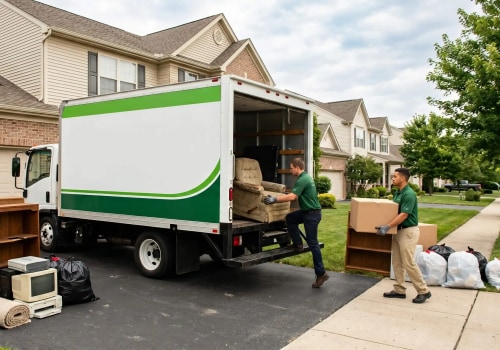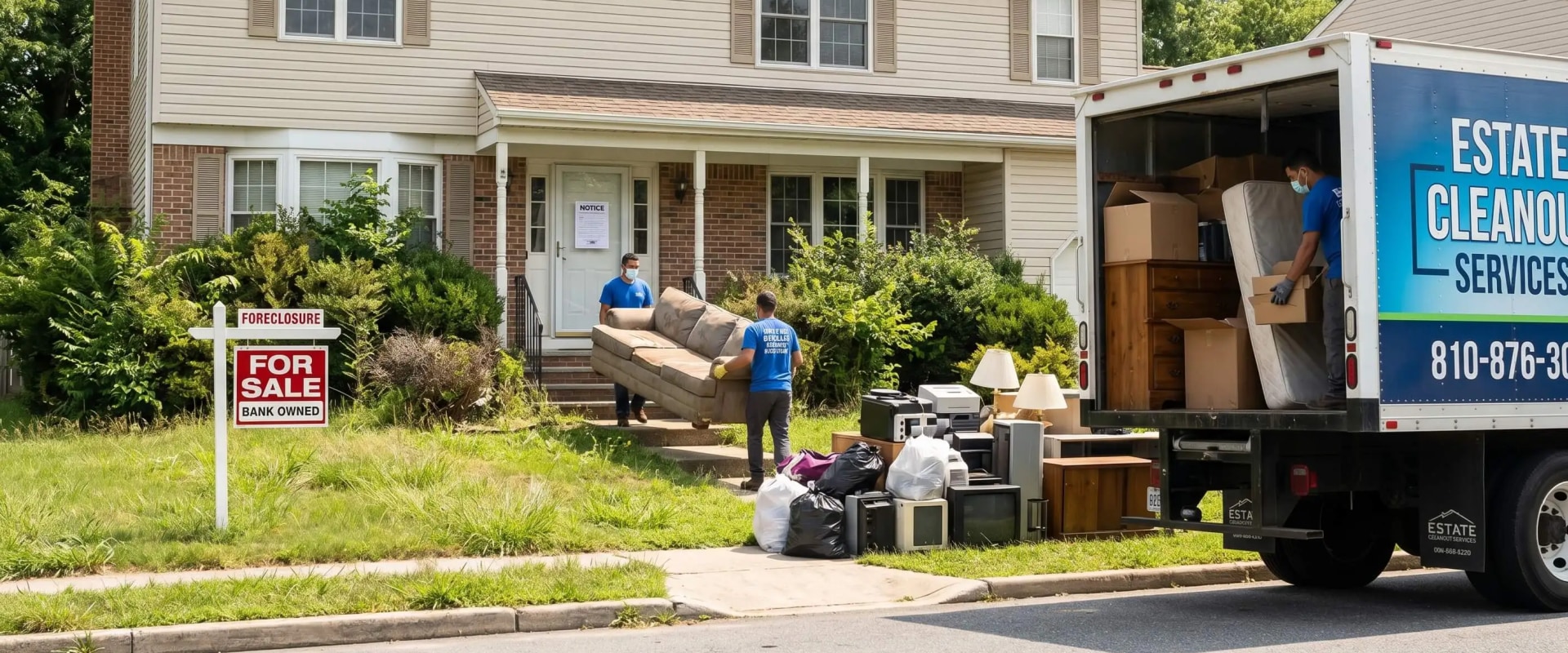
Estate foreclosure cleanouts pricing gives families a clearer way to understand what they’re actually paying for before the work begins. When pricing is transparent, it helps prevent surprise fees, keeps the project on budget, and makes it easier to compare quotes with confidence. Foreclosure cleanouts include unique cost drivers that standard residential rates may not cover, but knowing those factors upfront can help families plan the cleanout smoothly and avoid unexpected expenses.
Most cleanouts run between $1,500 and $10,000, with mid-size homes typically averaging $3,000 to $5,500. The spread inside that range comes down to truckload volume, accessibility, item type, and regional disposal fees. Most operators only explain those four cost drivers after the contract is signed. Knowing what each one actually means is how families avoid paying for the same cleanout twice.
TL;DR Quick Answers
estate foreclosure cleanouts pricing
Estate foreclosure cleanout pricing typically runs $1,500 to $10,000, with mid-size homes averaging $3,000 to $5,500. Foreclosure-specific cleanouts (REO trash-outs and zombie-foreclosure properties) usually run 10 to 25 percent higher than standard estate cleanouts because of bank-mandated photo documentation, sealed-property protocols, and compressed inspection timelines.
What drives the price:
Truckload volume. One to four full loads is typical. Truckloads predict cost more reliably than square footage.
Accessibility. Stairs, narrow hallways, and no elevator access add labor time fast.
Specialty items. Pianos, hot tubs, refrigerant appliances, and electronics carry separate fees from $25 to $500 per item.
Regional disposal fees. Urban markets quote higher than rural ones.
Foreclosure-specific add-ons. Documentation requirements, biohazard contingencies, and tight inspection timelines layer additional cost onto REO work.
Cost ranges by home size:
Under 1,000 sq ft: $1,000 to $3,000
1,000 to 2,000 sq ft: $2,500 to $5,500
2,000 to 3,500 sq ft: $4,000 to $8,000
3,500+ sq ft: $7,000 to $15,000 or higher
The single most reliable way to control cost: request a written, all-inclusive estimate after an in-person or video walkthrough. Confirm that disposal, accessibility, and specialty-item charges are included before signing. Phone-only quotes almost always grow once the crew arrives.
Top Takeaways
• Most estate cleanouts cost $1,500 to $10,000. Mid-size homes typically run $3,000 to $5,500, with truckload volume, accessibility, and item types driving the spread inside that range.
• Foreclosure cleanouts (REO trash-outs) work differently. Bank-mandated photo documentation, sealed-property protocols, and compressed timelines add cost layers that standard estate cleanouts don't carry.
• Hidden fees are avoidable with the right questions. Ask about minimum charges, stair surcharges, specialty-item premiums, fuel charges, and whether disposal is included before signing any quote.
• Donation routing is the most effective legitimate way to lower a quote. Habitat ReStore and Salvation Army offer free pickup for usable items. Every donated truckload subtracts one from your invoice.
• DIY math changes fast above 1,500 sq ft. Small properties can be DIY-economical at $200 to $500. Mid-size and larger estates often come out cheaper with professional service once you factor in dump runs ($50 to $150 each), truck rental, and time off work.
What Actually Drives Estate Cleanout Pricing
Square footage shows up in almost every estate cleanout quote because it's an easy number to ask for over the phone. As a predictor of final cost, it falls short. After working alongside cleanout crews across our partner network for years, four factors do most of the work of explaining the bill:
1. Volume of items, measured in truckloads. Most estate cleanouts require one to four full loads. A 1,500 sq ft home packed floor to ceiling can easily run three loads, and a lightly furnished 3,000 sq ft home might need only one. The number of trips to the transfer station drives both labor hours and disposal fees.
2. Accessibility. Third-floor walkups, narrow staircases, long driveways, and properties without elevator access add labor time fast. We've watched accessibility alone create $500 differences between two homes with otherwise identical contents.
3. Item types and special handling. Standard furniture and household goods are straightforward. Pianos, hot tubs, refrigerant appliances, electronics, and hazardous materials like paint or chemicals require special handling and disposal fees that get billed separately.
4. Regional disposal fees. Landfill and recycling charges vary by region. Urban markets with higher dump fees produce higher cleanout quotes, the same way they produce higher rates for any other waste-related service. A cleanout in San Francisco won't carry the same disposal line item as the same cleanout in rural Iowa.
Once you understand those four drivers, the dollar ranges by home size start making sense. Based on the cleanouts we see across our partner network, here's what most families can expect:
• Under 1,000 sq ft (studios, one-bedrooms, small apartments): $1,000 to $3,000.
• 1,000 to 2,000 sq ft (most three-bedroom homes): $2,500 to $5,500. This is the most common range we see.
• 2,000 to 3,500 sq ft (four-bedroom homes with basements or garages): $4,000 to $8,000.
• 3,500+ sq ft (large estates with outbuildings): $7,000 to $15,000 or higher. Heavily packed properties in this range can climb past $20,000.
These ranges assume full-service cleanout, including labor, hauling, and standard disposal fees. For a deeper look at cost-per-square-foot pricing and how reputable operators structure their quotes, the Jiffy Junk team published a detailed estate cleanout cost breakdown that pairs well with the framework below.
How Foreclosure Cleanouts Differ From Standard Estate Cleanouts
A standard estate cleanout is usually family-driven. Someone has passed away, the executor sorts through personal items, the family coordinates donations, and timelines flex around grief and probate court. A foreclosure cleanout works on a different clock. The bank or servicer drives the schedule, needs the property cleared, photographed, and sale-ready on a fixed timeline, and often layers in HUD-mandated documentation requirements.
Foreclosure cleanouts (the industry calls them "trash-outs" in REO work) carry cost drivers standard estate cleanouts don't:
• Photo documentation requirements. Bank asset managers expect dated, geotagged photos at multiple stages: pre-cleanout condition, midpoint progress, and post-cleanout completion. That's labor time billed into the quote.
• Sealed-property protocols. Lockbox coordination, key handoff procedures, and chain-of-custody requirements add scheduling complexity that adds hours to every job.
• Unknown property conditions. Standard estates come with a family member who can answer questions about what's in the basement. Foreclosed properties often don't. We've seen quoted jobs triple in size after a hidden basement workshop or attached storage unit was opened.
• Biohazard and hoarding contingencies. Vacant properties, especially zombie foreclosures, sometimes carry rodent infestation, mold, or worse. Those conditions require specialized PPE, separate disposal protocols, and sometimes a follow-up sanitization pass.
• Compressed timelines. REO closings, foreclosure auctions, and HUD inspection windows don't move. When a cleanout has to happen inside a 72-hour window, scheduling premiums of 15 to 25 percent over standard rates are common.
REO trash-outs and pre-foreclosure cleanouts also differ from each other. Pre-foreclosure work happens while the homeowner is still negotiating with the lender, which means personal items still belong to the homeowner and can't be discarded without explicit instruction. REO cleanouts come after the bank has taken possession, and state abandonment laws govern how personal property gets handled.
The Hidden Fees That Inflate Estate Cleanout Quotes
Across the cleanout work the site has covered for years, the same hidden charges keep showing up in customer complaints. Each one has a question you can ask before signing that prevents the surprise:
5. Minimum-truckload charges. A single load might be priced at $400, but the company's minimum is $600. Worth asking: "What's your minimum charge regardless of volume?"
6. Stair and elevator surcharges. Some operators quote ground-floor labor and add upper-level fees later. Worth asking: "Is accessibility included in this quote, or is there a stair fee?"
7. Specialty-item premiums. Mattresses ($25 to $75 each), refrigerant appliances ($35 to $100), pianos ($150 to $400), hot tubs ($200 to $500), and electronics ($25 to $50 per unit) commonly carry separate fees. Worth asking: "Which items in my home will trigger specialty surcharges?"
8. Fuel and travel charges. Properties outside a service radius can pick up fees of $50 to $200 per trip. Worth asking: "Does my address fall inside your standard service area?"
9. "Labor only" quotes that exclude disposal. This is the costliest surprise. A quote that doesn't include landfill and recycling fees can leave you paying $200 to $800 in dump fees on top of the labor invoice. Worth asking: "Are all disposal and landfill fees included in this number?"
The simplest protection against hidden fees is straightforward. Get a written, all-inclusive quote after an in-person or video walkthrough. Phone-only quotes are guesses, and they grow once the crew sees what they're actually working with.
How to Save Money on an Estate Cleanout Without Cutting Corners
Most of the legitimate cost-reduction moves we see on estate cleanouts happen before the crew arrives. Five tactics consistently move the bill in the right direction:
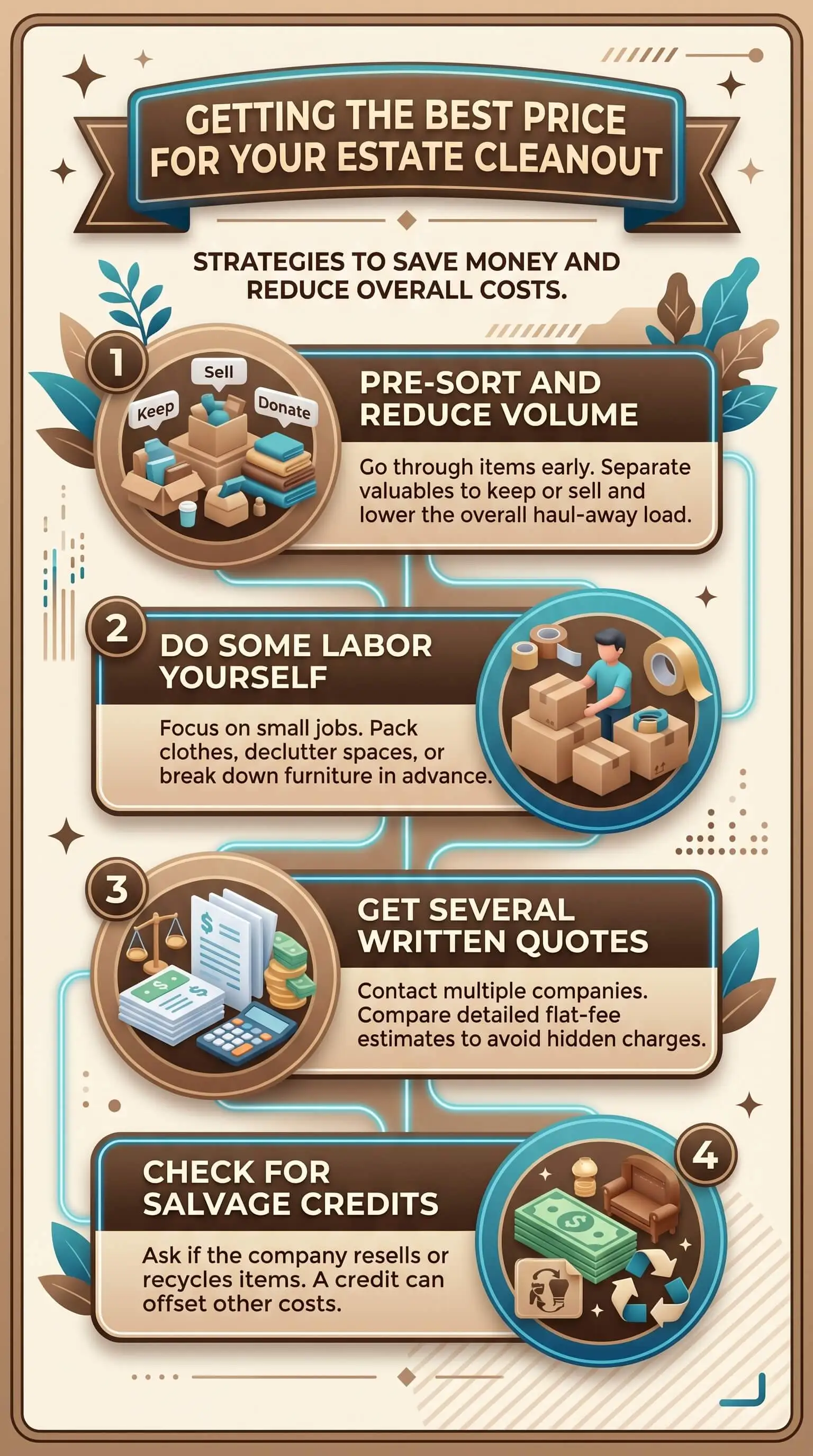
10. Pre-sort donatable items and route them off the truckload count. Habitat ReStore and Salvation Army both offer free pickup for furniture and appliances in usable condition. Every truckload of donatable items you send through donation channels is a truckload not billed in disposal fees.
11. Pull saleable items for an estate sale or online resale. Antiques, collectibles, jewelry, and quality furniture often hold meaningful value. The American Society of Estate Liquidators directory lists certified professionals if the property contains items worth appraising.
12. Request three written quotes after in-person walkthroughs. Three estimates give you a reasonable range and help you spot outliers. Suspiciously low phone quotes almost always grow during the job, and inflated quotes from less efficient operations stand out against two competitive bids.
13. Confirm disposal is included in writing. This single line item separates honest pricing from quotes designed to balloon. If the quote doesn't say "all disposal and landfill fees included," assume they aren't.
14. Be fully transparent during the walkthrough. Open every closet. Mention the shed out back. Show them the attic. Hidden surprises during the job lead to revised pricing, and the revision is rarely in your favor.
On the DIY question, small lightly furnished properties can run $200 to $500 in dump fees and truck rental if you handle the work yourself. The math changes fast on mid-size and larger estates. Multiple dump runs at $50 to $150 each, truck rental at $80 to $150 per day, time off work, and the injury risk of hauling a refrigerator down a flight of stairs all stack up quickly. Professional cleanout often comes in at the same number or lower, with insurance coverage and a fixed completion timeline added in.
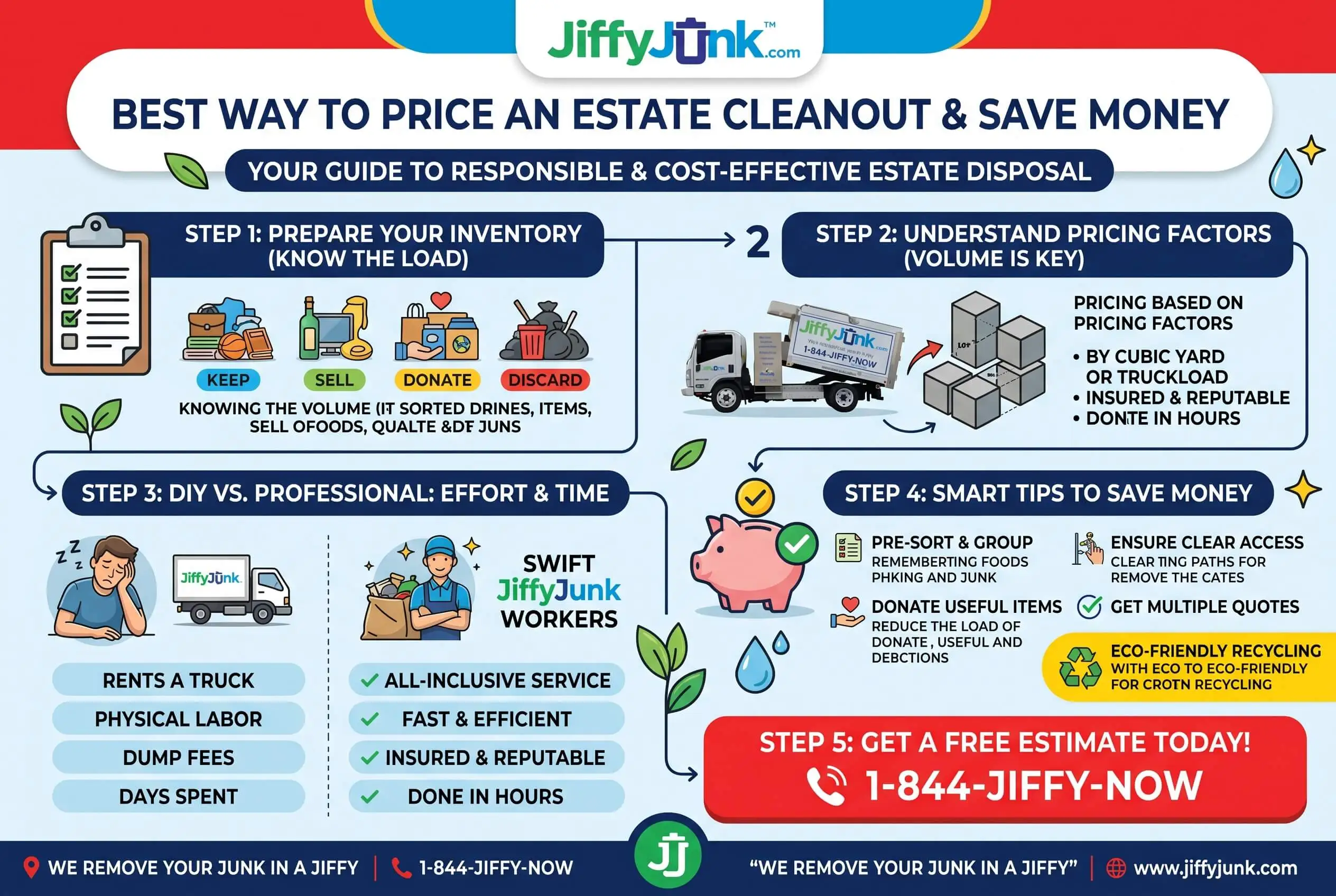
"While families worry about choosing the wrong company, the most expensive mistake on an estate cleanout is accepting a phone quote without an in-person walkthrough. Across thousands of cleanouts our partner network has handled, a 15-minute property visit catches every surprise-fee complaint we've ever heard about. The companies skipping the walkthrough are the ones generating those complaints. Phone quotes are guesses dressed up as numbers. The operator who walks the property, opens every closet, asks about the basement, and asks about the shed out back is the one giving you a quote you can actually hold them to. That single decision saves families more money than any other tactic in this whole process."
7 Essential Resources
Each resource below answers a specific question that tends to come up while pricing a cleanout, vetting a provider, or working through the legal side of an estate or foreclosure. Bookmark the ones that match your situation.
1. ATTOM — U.S. Foreclosure Market Reports
The industry-standard source for monthly, quarterly, midyear, and annual U.S. foreclosure activity data. Coverage spans default notices, scheduled auctions, and bank repossessions across more than 3,000 counties, accounting for 99 percent of the U.S. population.
Why this helps: If you're trying to gauge how active the foreclosure market is in your state or metro before pricing out work on a distressed property, ATTOM is the data set every other source builds on top of. State and metro breakdowns help you anchor regional cost expectations.
Resource: attomdata.com — Foreclosures Archives
2. U.S. Department of Housing and Urban Development — Avoiding Foreclosure
HUD's federal-authority page for homeowners facing foreclosure, with HUD-approved counselor referrals, process explanations, links to assistance programs, and contact information for state housing finance agencies. Covers both pre-foreclosure options and what happens after the foreclosure proceeds.
Why this helps: If the cleanout you're pricing involves a property still in pre-foreclosure, this page is the right starting point for the homeowner side of the conversation before any cleanout work begins.
Resource: hud.gov — Avoiding Foreclosure
3. Consumer Financial Protection Bureau — What Is Foreclosure?
Plain-language federal explainer on the foreclosure process, the timeline, the consumer rights at stake, and what to expect at each step. Written for homeowners, but useful for executors and family members trying to figure out where a property sits in the foreclosure timeline.
Why this helps: Helps you tell the difference between pre-foreclosure cleanout work, where personal property still belongs to the homeowner, and post-foreclosure REO cleanout work, where the bank has taken possession. That distinction changes what you can legally discard.
Resource: consumerfinance.gov — What Is Foreclosure?
4. EPA — Durable Goods: Furniture and Furnishings Data
Federal source for U.S. furniture-disposal statistics, with generation, recycling, and landfill data going back to 1960. The 12.1 million tons figure cited in the next section comes directly from this dataset.
Why this helps: Tells you how much of what gets cleared out of estates ends up in landfills versus being recycled or donated. Useful context when weighing whether donation routing is worth the time it adds to a cleanout schedule.
Resource: epa.gov — Durable Goods: Product-Specific Data
5. Habitat for Humanity ReStore — Donate Goods
Nationwide free pickup network for furniture, appliances, and building materials in good condition. Habitat ReStore operates over 900 locations across the country and provides tax-deductible receipts for accepted donations.
Why this helps: Routing donatable items to Habitat ReStore before the cleanout crew arrives is one of the most direct ways to lower a cleanout quote. Every truckload moved through donation is a truckload not billed in disposal fees.
Resource: habitat.org — ReStore Donation Program
6. American Bar Association — Guidelines for Individual Executors and Trustees
Authoritative legal guidance on executor and trustee responsibilities, including handling of estate property, documentation requirements, and the standard procedures for property settlement. Written by the ABA Real Property, Trust and Estate Law Section.
Why this helps: If you're acting as an executor or trustee, this page covers the fiduciary obligations that shape every cleanout decision: what you can hand off to a crew, what needs documentation first, what timeline pressure you're working against, and what risks you carry personally.
Resource: americanbar.org — Executor & Trustee Guidelines
7. FTC — How to Avoid a Home Improvement Scam
Federal Trade Commission consumer-protection guide on red flags when hiring contractors and service providers. Covers warning signs of fraudulent operators, questions to ask before signing, and credentials to verify.
Why this helps: The same red flags the FTC catalogs for home-improvement scams apply word for word to cleanout-company scams. Vague pricing, demands for cash up front, reluctance to provide written quotes, and pressure to sign on the spot are the patterns to watch for.
Resource: consumer.ftc.gov — How to Avoid a Home Improvement Scam
3 Statistics
367,460 U.S. Properties Had Foreclosure Filings in 2025, Up 14% From 2024
ATTOM's Year-End 2025 U.S. Foreclosure Market Report (published January 2026) shows foreclosure filings reached 367,460 properties in 2025, with default notices, scheduled auctions, and bank repossessions all rising for the first full calendar year since the pandemic-era moratoria ended. That figure represents 0.26 percent of all U.S. housing units, well below the 2010 peak but climbing for nine consecutive months entering year-end.
For families and asset managers pricing out cleanout work in 2026, the practical implication is timing. More foreclosed properties moving through the system means cleanout demand is rising, schedule availability is tightening in the most active states (Florida, Texas, California, Illinois, New York), and the providers worth hiring are booking further out than they were a year ago. This is especially important when a property is being prepared for kitchen remodeling, where a timely cleanout can create a safer, clearer workspace and help the renovation move forward with fewer delays.
Source: ATTOM — U.S. Foreclosure Activity Increases in 2025
12.1 Million Tons of Furniture Discarded Annually, with About 80% Going to Landfill
EPA's most recent durable-goods analysis puts U.S. furniture and furnishings generation at 12.1 million tons per year. Roughly 80 percent of that volume goes straight to landfill. Furniture recycling rates are effectively negligible, because modern multi-material construction, with mixed wood, foam, fabric, metal, and plastic in a single piece, makes separation cost-prohibitive at scale.
That landfill-default behavior is the single largest avoidable cost driver on an estate cleanout. Disposal fees scale with truckload volume. Every donatable couch, dresser, or appliance you send to Habitat ReStore or Salvation Army before the cleanout crew arrives subtracts a truckload from your invoice. We've seen pre-sort donation routing trim 15 to 25 percent off final cleanout costs on properties with substantial usable furniture.
Source: U.S. EPA — Durable Goods: Product-Specific Data
1.32% of U.S. Residential Properties Sat Vacant in Q4 2025, with 3.25% of Pre-Foreclosure Properties Classified as Zombie Foreclosures
ATTOM's Q4 2025 Vacant Property and Zombie Foreclosure Report shows 1.32 percent of residential properties sat vacant entering Q4 2025, with 3.25 percent of pre-foreclosure properties qualifying as zombie foreclosures, meaning the occupants have abandoned the property but the lender hasn't yet repossessed it. These properties often sit untended for months or years before any cleanout crew sees them.
Zombie foreclosures are a primary source of complex, high-cost cleanout work, and they're a major reason foreclosure cleanout pricing tends to run higher than standard estate cleanout pricing on a per-square-foot basis. Long vacancy means accumulated water damage, pest infestation, mold growth, and abandoned personal property that the cleanout crew has to inventory and document before discarding. Pricing a zombie foreclosure cleanout from photos alone is a recipe for a revised invoice.
Source: ATTOM — Vacant Property and Zombie Foreclosure Reports
Final Thoughts and Opinion
Across the cleanout work the site has covered for years, customer information access predicts pricing fairness more reliably than company overhead does. Families that walk the property with three vetted bidders, ask specifically about minimums, accessibility surcharges, and disposal inclusion, and demand a written all-inclusive quote consistently get fairer pricing than families who accept the first phone estimate.
The pattern stays consistent. The lowest phone quote almost never ends up the lowest final invoice. Operators willing to walk the property in person, open every closet and storage room, and ask about outbuildings are the ones giving numbers you can actually hold them to. That single discipline matters more than any other decision in the pricing process, foreclosure cleanouts included.
When the timeline is tight, with a real estate closing, a probate court deadline, or a foreclosure inspection window approaching, professional cleanout exists for exactly that gap. A transparent in-person quote is the right starting point, and the operators worth hiring will offer one for free.
Frequently Asked Questions
How much does an estate cleanout cost on average?
Most estate cleanouts cost between $1,500 and $10,000, with mid-size homes typically running $3,000 to $5,500.
Square footage alone is a weak predictor. A 1,500 sq ft home lived in for 40 years routinely costs more to clear than a 3,000 sq ft home occupied for five. Truckload volume, accessibility, item types, and regional disposal fees explain almost all of the spread inside that range. The only reliable way to get an accurate quote is an in-person or video walkthrough. Phone estimates based on square footage frequently miss the mark in both directions.
What is the difference between an estate cleanout and a foreclosure cleanout?
An estate cleanout is family-driven and focused on sorting personal items, donations, and probate-related paperwork. A foreclosure cleanout (industry shorthand: "trash-out") is bank- or asset-manager-driven, with stricter documentation, sealed-property protocols, and tighter timelines.
Foreclosure cleanouts also tend to involve unknown property conditions, sometimes badly so on long-vacant zombie-foreclosure properties. The pricing reflects that uncertainty, with most providers building a contingency premium of 10 to 25 percent into REO quotes that wouldn't appear on a standard estate cleanout.
How is estate cleanout pricing calculated?
Operators calculate pricing on truckload volume, accessibility, item types requiring special handling, and regional disposal fees. They ask for square footage because it's an easy number to get over the phone, but as a final pricing measure, square footage is a starting point at best.
Reputable operators will price a job after walking the property in person or via a recorded video tour. The quote should be written, all-inclusive, and itemized enough that you can see what's covered and what isn't. If a company is unwilling to put their estimate in writing or to walk through what's included, that's the signal to keep looking.
What hidden fees should I watch for on an estate cleanout quote?
Five hidden fees come up the most. The first is minimum-truckload charges, where a $400 load gets priced against the company's $600 minimum. The second is stair and elevator surcharges added later for upper-floor items. The third is specialty-item premiums on mattresses, refrigerant appliances, pianos, hot tubs, and electronics. The fourth is fuel and travel charges for addresses outside the service radius. The fifth, and the most expensive surprise, is a "labor only" quote that excludes landfill and disposal fees entirely.
Each fee has a question you can ask before signing that prevents the surprise. Is disposal included in this number? What's your minimum charge regardless of volume? Is accessibility part of the base rate, or does an upper-floor surcharge get added later? Which items in my specific property will trigger specialty premiums? Honest operators will answer all four on the spot, in writing.
How can I save money on an estate cleanout without cutting corners?
Pre-sort donatable items to free pickup services like Habitat ReStore or Salvation Army before the crew arrives, pull saleable pieces for an estate sale or online resale, request three written quotes after in-person walkthroughs, confirm in writing that disposal is included, and be fully transparent during the walkthrough so the quote reflects the actual scope of work.
Three cost-cutting moves to avoid. Hiring uninsured operators leaves you with liability exposure that dwarfs any savings. Accepting phone-only quotes almost always means watching the number grow once the crew arrives. Chasing the lowest bid without confirming what's actually included frequently lands at the highest final invoice. The cheapest written quote with all disposal fees included is usually the right answer. The cheapest phone quote almost never is.
Is a foreclosure cleanout more expensive than a standard estate cleanout?
Often yes, particularly on properties that have been vacant for an extended period. Foreclosure cleanouts add documentation requirements, biohazard or hoarding contingencies, and time-pressure scheduling premiums that standard estate cleanouts don't carry.
On comparable properties cleaned out in similar condition, the cost difference is usually 10 to 25 percent. On long-vacant zombie-foreclosure properties with water damage, pest activity, or accumulated abandoned property, the gap can run higher. Bank asset managers know this and build it into their cleanout budgets, and family executors handling a foreclosure-adjacent estate cleanout should expect the same.
Get a Transparent Cleanout Quote Before the Deadline Arrives
If your closing is two weeks out, the probate court is asking for property status, or the foreclosure inspection window has already opened, the cleanout question stops being theoretical. Your next move is a free, in-person walkthrough with a licensed and insured cleanout provider, and a written all-inclusive quote in hand before any work begins.
For a deeper look at how reputable junk removal services structure estate and whole-house cleanout pricing, compare Jiffy Junk's detailed estate cleanout cost breakdown. The post covers exactly what an honest quote includes, which line items should never appear as a post-job surprise, the questions every family should ask during the walkthrough, and what families consistently overlook before signing.