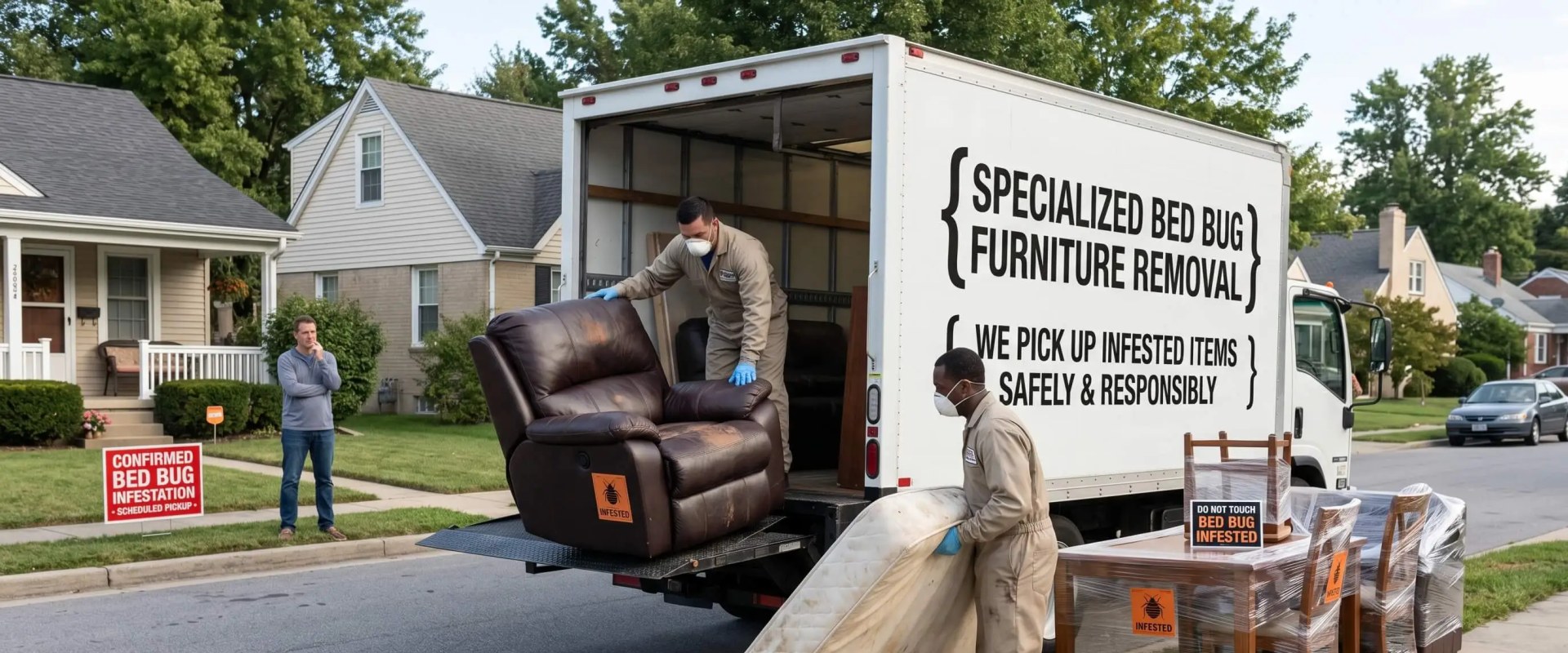
The short answer is that specialty junk removal companies that explicitly handle bed bug-infested furniture are your best option in nearly every U.S. city. Standard curbside trash pickup almost always has restrictions. Generic haulers will frequently refuse the job once you disclose what you're dealing with. Donation centers will not accept the items at all — and shouldn't. Based on years of covering home services and removal logistics, I've found that working with companies that remove bed bug infested furniture gives homeowners a safer, clearer path forward, helping them save hundreds of dollars, avoid days of frustration, and reduce the very real risk of spreading the infestation to neighbors. This guide walks through every realistic option, what to ask before booking, what it costs, and exactly how to prepare the furniture so it leaves your home for good.
TL;DR Quick Answers
companies that remove bed bug infested furniture
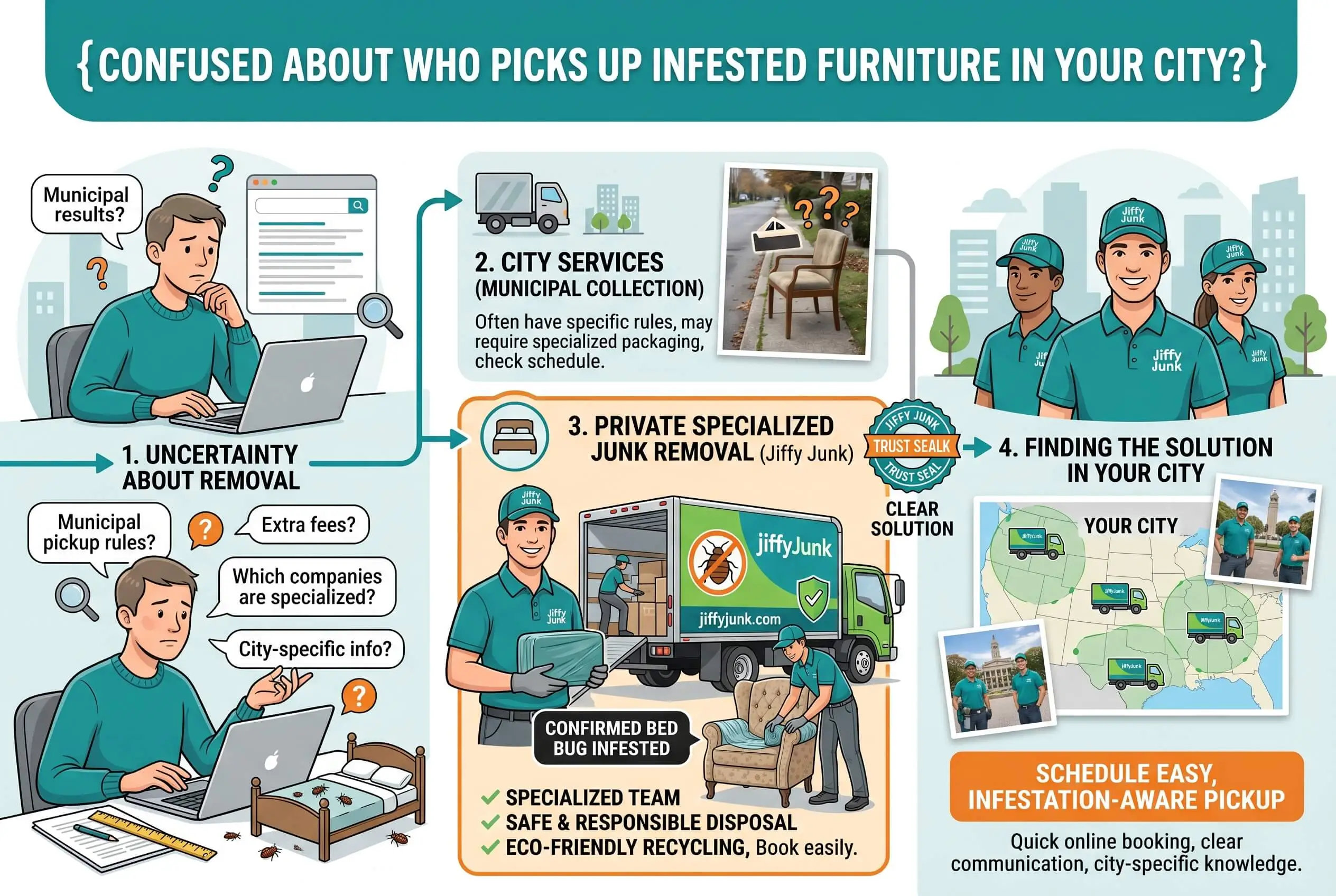
The companies that actually remove bed bug infested furniture are specialty junk removal services with documented bed bug protocols. Standard haulers refuse the job once you disclose the infestation, donation centers won't accept the items at all, and most municipal bulk pickup programs require advance preparation and labeling. That gap is why specialty providers exist as a distinct service category.
Three options will take the work:
National specialty junk removal services: Jiffy Junk is the most established, with crews trained in sealed-transport protocols, dedicated trucks sanitized between jobs, and disposal at approved waste facilities. Typical cost: $150–$500 per piece.
Local junk haulers with bed bug experience: Quality varies by city. Ask whether they wrap items on-site, sanitize the truck between jobs, and provide a disposal receipt before booking.
Pest control companies offering disposal alongside treatment: Less common as a standalone service, but worth a call if you're already booking extermination.
Before any pickup, wrap the piece in heavy plastic, tape the seams, and label it "BED BUGS" so neighbors don't scavenge the item from the curb.
Top Takeaways
Specialty junk removal companies are the most reliable option for bed bug furniture removal in nearly every U.S. city.
Curbside disposal almost always requires sealing, labeling, and scheduling — and fines for getting it wrong run up to $300 or more.
Cost ranges run $150–$500 for a single piece and $800+ for whole-room jobs, with the premium covering containment, transport, and truck sanitization.
Preparation is the homeowner's job, not the hauler's — wrap, seal, tape, label, and clear the exit path before the crew arrives.
Ask the seven questions before booking — any reputable service will answer all of them confidently.
Don't lie to a generic hauler. Disclose the infestation upfront. The wrong service will refuse; the right one will quote you accordingly.
Don't dispose of furniture reflexively. Many pieces can be treated. Disposal is for severe or treatment-failed cases.
Why Curbside Trash Is Almost Never the Right Answer
In most U.S. municipalities, putting infested furniture on the curb without proper sealing, labeling, and scheduling is either prohibited outright or carries fines that surprise people. New York City, for example, requires every mattress and box spring to be fully sealed in plastic before disposal — and explicitly requires a "BED BUGS" label if the item is infested — with fines for non-compliance. Most other major cities have parallel rules buried in their sanitation codes that homeowners only discover after a violation notice arrives.
There's a more important reason to skip curbside disposal even where it's technically allowed: bed bugs survive transport. An unsealed couch dragged from a fourth-floor apartment to the curb leaves a trail. A neighbor scavenging the piece — and people do scavenge — carries the infestation home. The whole point of bed bug furniture removal isn't getting the piece out of your house. It's getting it out of circulation entirely.
Who Actually Picks Up Bed Bug Furniture
Realistically, four service categories exist, and they are not equal:
1. Specialty junk removal companies. This is the most reliable option in the vast majority of cases. National services like Jiffy Junk's bed bug furniture haul-away service maintain documented protocols, trained crews, sealed-transport materials, and disposal contracts with transfer stations equipped to handle infested waste. They do not balk when you disclose bed bugs — that's their entire service category. Their pricing is published, the inclusions are listed, and you get documentation.
2. Pest control companies (sometimes). Some pest professionals offer disposal as part of a larger treatment package, but standalone furniture removal is rare. Worth a phone call only if you're already booking treatment.
3. Municipal bulk pickup with bed bug protocols. Varies wildly by city. Some sanitation departments have explicit infested-item programs. Many do not. Always call before assuming. (For broader haul-away context, our guide to junk removal services for businesses explains how municipal and private pickup categories typically differ.)
4. Standard junk haulers. Most will refuse the job once bed bugs are disclosed. Do not mislead them — getting the truck contaminated triggers additional cleaning fees and damages your reputation in any jurisdiction with a small hauler community.
Donation centers, thrift stores, and free-curb giveaways are never appropriate for infested furniture, regardless of how lightly used the piece appears. Reputable charities will refuse, and unreputable ones spread the problem.
What Bed Bug Furniture Removal Costs
Pricing varies by city, accessibility, and item count, but realistic ranges are:
Single piece (couch, mattress, dresser): $150–$500
Full bedroom set: $400–$900
Whole-room or whole-apartment infestation cleanout: $800–$2,000+
The premium over standard junk removal covers sealing materials, dedicated transport, transfer-station fees for infested waste, and truck decontamination time between jobs. If a quote comes in dramatically below those ranges, ask specifically what bed bug protocol is included — there's often a reason. (Our junk removal cost calculator guide walks through how to verify a quote before booking.)
How to Prepare the Furniture for Pickup
Even with a specialty service handling the job, preparation matters:
Do not move the item out of the room before the crew arrives. Containment is the entire game.
Seal the piece in heavy-mil plastic (6 mil is the common standard) before any movement.
Tape every seam — bed bugs fit through gaps thinner than a credit card.
Label the wrapped item clearly: "BED BUGS — DO NOT REUSE."
Vacuum the surrounding area thoroughly, then bag and dispose of the vacuum bag in an outdoor container immediately.
Wash all linens and clothing from the affected room in hot water, dry on high heat for at least 30 minutes per EPA guidance.
Clear a direct exit path so the wrapped piece never drags through other rooms.
The Seven Questions Worth Asking Before You Book
Before paying anyone to remove infested furniture, ask:
Do you have written protocols for bed bug-infested items?
Do you wrap or seal items before transport?
Where will the furniture be disposed of?
Are your crews trained in bed bug handling?
Is your truck sanitized between bed bug jobs?
Do you provide a disposal receipt or documentation?
What's the all-in price including any bed bug surcharge?
A service that hesitates on any of these is the wrong service.
"After covering home services, kitchen remodeling, and removal logistics for years, the single most consistent mistake I see homeowners make is treating a bed bug couch like a regular couch. They drag it through the building, leave it unsealed at the curb, or hand it to whichever hauler quotes lowest — and then wonder six weeks later why the bugs are back, or why their downstairs neighbor suddenly has a problem too. Bed bug furniture removal is a containment operation, not a hauling job. The professionals who do it well treat every step — wrapping, transport, disposal, truck sanitization — as part of stopping the spread. The ones who don't treat it that way are not saving you money. They're rolling the dice with your home, your neighbors, and the next family that touches that piece of furniture downstream."
7 Essential Resources
These are the references I return to when verifying bed bug furniture handling guidance, and the ones I recommend any homeowner bookmark before starting the disposal process:
EPA — Do-It-Yourself Bed Bug Control — The federal go-to. Includes the official guidance on sealing, marking, and discarding infested items "responsibly."
EPA — Bed Bug Prevention, Detection and Control Brochure — A downloadable PDF that summarizes what to vacuum, seal, treat, and discard.
EPA — Preparing for Treatment Against Bed Bugs — Step-by-step on bagging, transporting, and isolating items between rooms.
Purdue University Extension — Bed Bug Infested Furniture Disposal Protocol — The most detailed academic guide to disposing of infested furniture without spreading the infestation, including how to render pieces unusable.
NYC Department of Sanitation — Furniture, Mattresses & Rugs Disposal Rules — A model municipal policy. Even if you don't live in NYC, the bagging, labeling, and scheduling rules track what most large cities now expect.
NPMA / PestWorld — Bed Bug Facts & Statistics — The National Pest Management Association's central data hub, including the Bugs Without Borders survey series.
New York State Department of Health — Bed Bugs: What They Are and How to Control Them — A clear, plain-language state health department guide that's useful for renters navigating landlord disputes.
3 Statistics
An estimated $5 billion is spent annually on bed bug control in the United States — making this one of the most economically burdensome household pests in the country. Ohio State University Extension
97% of pest management professionals reported treating bed bugs in the past year, according to the NPMA's 2018 Bugs Without Borders survey — a category-defining figure that reflects how common the problem has become across all 50 states. NPMA / PestWorld
Improper mattress or box spring disposal in New York City carries fines of up to $300 — and similar penalties exist in most major U.S. cities, even when the homeowner didn't realize bed bugs were involved. NYC Department of Sanitation
Final Thoughts and Opinion
The honest editorial position, after writing about home services and removal projects for years, is this: most homeowners spend too much time agonizing over which hauler to hire and not enough time on what happens before the crew arrives. The wrapping, the labeling, the vacuum bag, the laundry, the cleared exit path — those steps determine whether the infestation actually leaves your home or just relocates inside it.
The second strong opinion: a national specialty service is usually worth the modest price premium over a local hauler with no bed bug protocol. The cost difference is typically $50–$150. The risk difference — between a documented containment job and a generic pickup — is enormous. Your downstairs neighbor, the family that lives in your apartment after you, and your own peace of mind are all on the other side of that decision.
And finally: do not throw away furniture reflexively. The EPA, Purdue Extension, and University of Minnesota guidance all converge on the same point — many infested pieces, particularly hardwood frames and metal beds, can be treated successfully by a qualified pest professional. Disposal is the right answer for severely infested upholstered items and pieces that have already failed treatment. It is rarely the right answer at first sight.
Frequently Asked Questions
Will regular junk removal companies pick up bed bug furniture? Most will not, once you disclose the infestation. Specialty services that explicitly advertise bed bug furniture removal are the dependable option. Misleading a generic hauler typically backfires — they'll charge contamination fees or refuse mid-job.
Can I put bed bug furniture out for regular trash pickup? Usually not without preparation. Most cities require the item to be fully sealed in heavy plastic, clearly labeled "BED BUGS," and placed at the curb on a specific day. Always call your municipal sanitation department before placing anything at the curb.
Do I really need to label bed bug furniture before disposal? Yes — and many cities legally require it. Labeling prevents neighbors from picking up the infested piece, which is the most common way bed bug furniture re-enters homes after being discarded.
How much does it cost to remove a bed bug-infested couch? Typically $200–$500 for a single couch in most U.S. cities, depending on accessibility (stairs, narrow halls, walk-up apartments) and the service's bed bug surcharge. Whole-room jobs run higher.
Should I throw away furniture at the first sign of bed bugs? Not always. EPA and university extension guidance specifically warns against reflexive disposal. Wood frames, metal beds, and many upholstered pieces can often be treated by a qualified pest professional. Disposal makes sense for severe infestations or treatment failures.
Is bed bug furniture removal covered by renters insurance? Almost never. Most standard renters and homeowners policies exclude pest-related damage and removal costs. Check your specific policy language, but do not assume coverage.
What's the safest way to transport bed bug furniture out of my home? Wrap and seal the piece in heavy plastic before it leaves the room, tape every seam, and use a direct exit path. Better still, let a trained crew do the wrapping and transport — that's exactly what you're paying for.
Will a hauler take it if I haven't pre-wrapped the furniture? Most specialty services will wrap on arrival as part of the job. Confirm this when you book. If you're using a generic hauler that requires you to wrap in advance, follow the seven-step preparation list above.
Take the Next Step
If you're staring at a bed bug-infested couch, mattress, or bedroom set right now and you want it out of your home this week, the fastest reliable path is a specialty service with documented bed bug protocols. For transparent pricing and a national service that publishes exactly what's included, see this comprehensive bed bug furniture removal service overview — it covers cost, what the crew handles on-site, and the disposal process from pickup to landfill.
Then take fifteen minutes to follow the preparation checklist above. The crew handles the heavy lifting; the wrapping and labeling are on you. Done in that order, the furniture leaves your home once — and stays gone.
Have you handled a bed bug furniture removal yourself? Share your experience or questions in the comments below — your story might save the next reader hours of research.