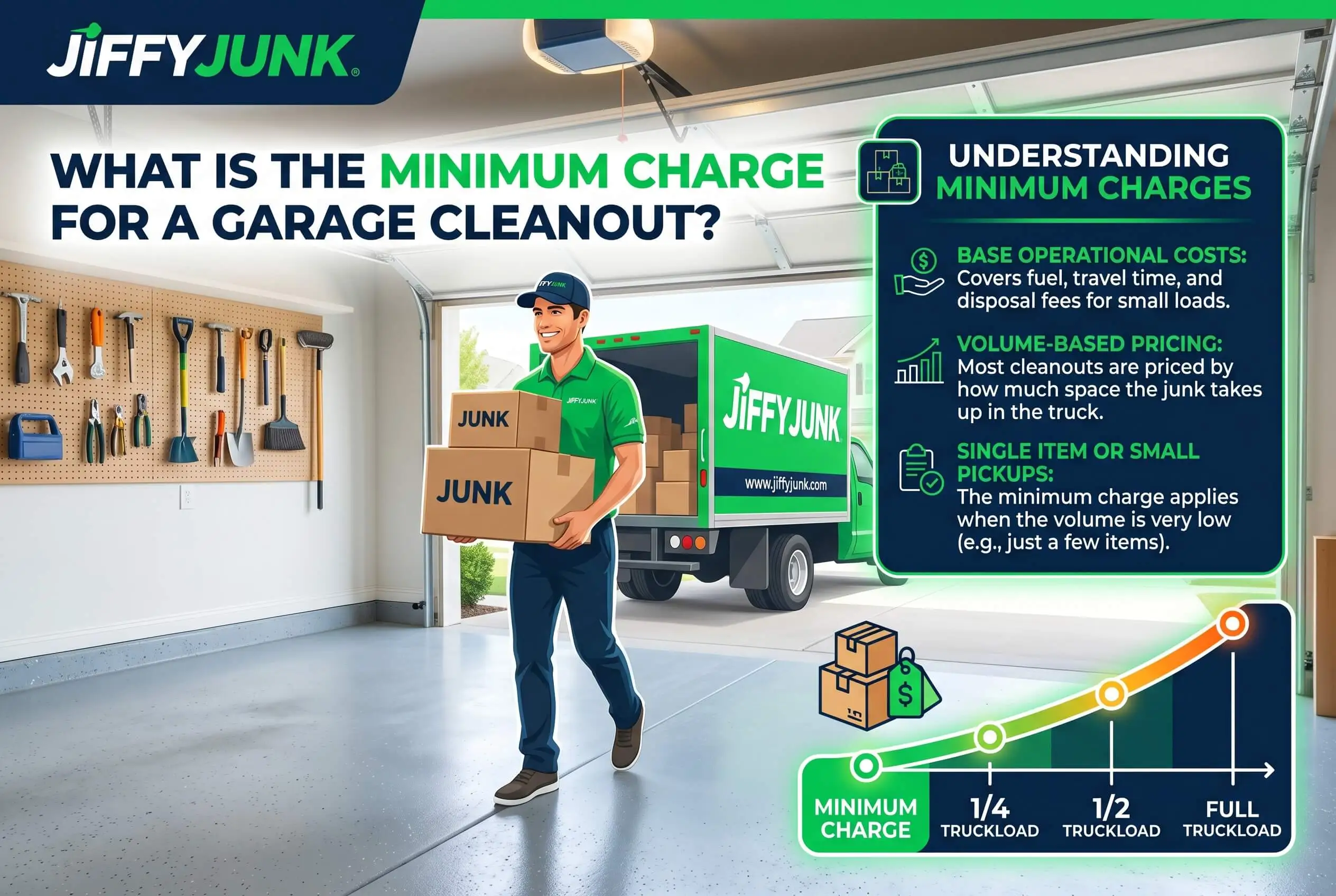
The answer makes sense once you understand what's actually being priced. A two-person crew, a sixteen-cubic-yard truck, a round trip to the transfer station, and a tipping fee at the dump don't get cheaper just because your load is small. The minimum charge reflects the actual cost of getting a hauler to your driveway, not arbitrary markup.
TL;DR Quick Answers
garage cleanout services cost
Garage cleanout services cost between $200 and $800 for most U.S. jobs, with a typical two-car garage averaging $400 to $600. The minimum charge is $100 to $175 even for very small loads, because every dispatch carries fixed costs that don't compress with volume.
Volume-based pricing tiers (not hourly):
Minimum (about 1/8 truck): $100–$175
Quarter truck: $175–$250
Half truck: $250–$400
Three-quarter truck: $425–$575
Full truck: $560–$800
What drives the price up: density (a packed single-car garage often costs more than a sparse two-car), heavy items (refrigerators add $50–$100, mattresses add $25–$75), e-waste ($5–$40 per item), and difficult truck access (15–25% surcharge).
What's not included: paint, propane tanks, automotive fluids, and pool chemicals. Those go through municipal hazardous waste programs.
Top Takeaways
The minimum garage cleanout services cost in the U.S. sits between $100 and $175 across most markets. That floor reflects fixed costs like crew dispatch, fuel, disposal fees, and insurance. It isn't an arbitrary markup.
Most cleanouts run $200 to $800. A two-car garage averages $400 to $600. The minimum charge applies only to genuinely small loads of about 1/8 truck or less.
Density matters more than garage size. A packed single-car garage often costs more than a sparse two-car. Volume drives pricing, not square footage.
Reputable haulers price by volume, not by hour. Hourly pricing without a cap is a red flag. Always get a written, capped quote before work starts.
Some items carry surcharges. Refrigerators add $50 to $100, mattresses add $25 to $75, e-waste runs $5 to $40 per item. Hazardous materials usually aren't accepted at all.
DIY is cheaper only for genuinely small loads. For a packed garage, the cost difference between DIY and professional service is smaller than most homeowners expect once truck rental, dump fees, and time are tallied honestly.
What "minimum charge" actually means in this market
The garage cleanout services cost structure most companies use is volume-based, typically priced by truckload fraction. A 16-cubic-yard truck is the industry standard. The minimum charge corresponds roughly to the first 1/8 of that truck, or about two cubic yards of items.
Here are the pricing tiers I see across the categories of haulers operating in the U.S. market:
Independent local haulers: $75–$130 minimum
Regional junk removal companies: $130–$175 minimum
National service brands (Jiffy Junk, College HUNKS, 1-800-Got-Junk): $150–$200 minimum
College HUNKS publishes a $150 starting price on its site. Junk South lists about $100 as its minimum. Fire Dawgs uses $130. The numbers stay remarkably consistent across the country because the underlying cost structure is the same for everyone.
For a residential garage of standard one- or two-car capacity, most cleanouts fall well above the minimum. Typical jobs land in the $200–$800 range, with a packed two-car garage averaging $400–$600 per Angi's 2026 cost data and Jiffy Junk's published averages. The minimum charge applies only when your load is genuinely small.
Why the floor exists in the first place
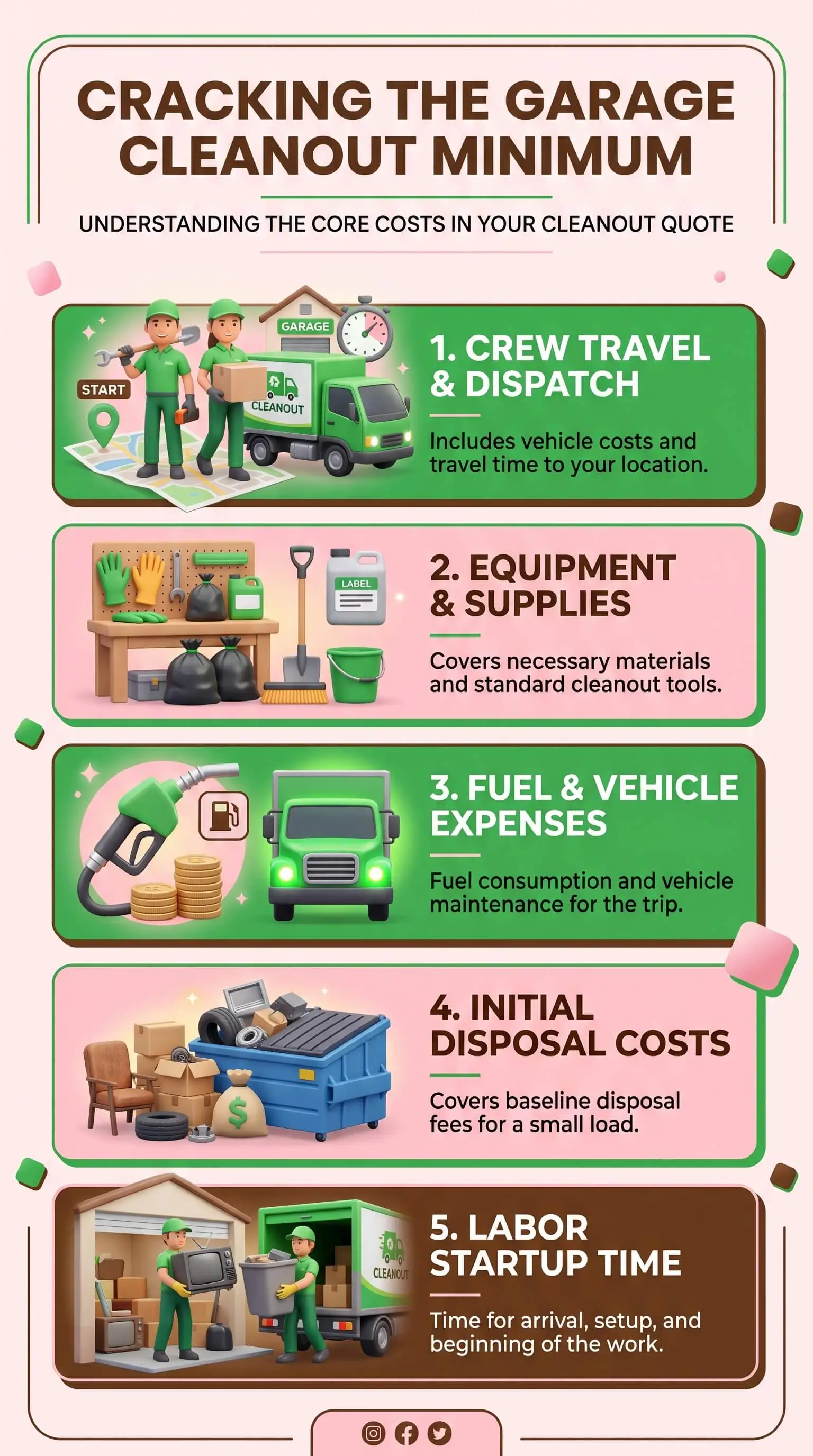
Every dispatch carries four built-in costs, regardless of load size:
Crew time. A two-person crew is on the clock from the moment they leave the yard. Driving time to your address, walkthrough, loading, return trip, and dump time all count as paid labor. Even a 30-minute job at your driveway represents 90 or more minutes of paid crew time.
Truck and fuel. Service vehicles typically get 8 to 12 miles per gallon. One job in a remote ZIP code burns the same fuel whether the truck leaves with two items or twenty.
Disposal fees. Landfill tipping fees average $50 to $100 or more per ton in most U.S. metros. Even a quarter-truck of household junk triggers a full transfer-station visit and the same minimum tipping charge.
Insurance and overhead. Licensed haulers carry general liability insurance and workers' comp. A quote that comes in under typical industry minimums often signals an unlicensed operator, which is a real liability if something gets damaged on your property or someone gets hurt mid-job.
A useful sanity check: if a hauler quotes you $50 for any size cleanout, ask to see their insurance certificate. Most reputable companies will produce it without hesitation. The ones that won't are the ones you can't afford to hire.
When you'll pay more than the minimum
Volume past 1/4 truck pushes you into tiered pricing fast. Half-truck loads typically run $250 to $400. Three-quarter loads land around $425 to $575. A full truckload averages $560 nationally and tops out around $700 to $800 for most residential jobs.
A few items carry their own surcharges that haulers add to the base quote. Refrigerators and freezers run an extra $50 to $100 because of refrigerant handling rules. Mattresses add $25 to $75. Old TVs and monitors run $5 to $40 each at most companies because of e-waste processing fees. Paint, propane tanks, automotive fluids, and pool chemicals usually aren't accepted at all. Those need to go through municipal hazardous waste programs.
Access matters more than people expect. A garage where the truck can back right up to the door costs less than one requiring the crew to haul items 50 feet down a side yard or up a flight of basement stairs. Detached garages with poor approach can add 15 to 25 percent to the quote. For a detailed breakdown of how the best garage cleanout and hauling companies structure pricing, compare how national operators handle these add-ons against local haulers in your market.
"After clearing out thousands of garages since 2014, we've found that the real value of professional cleanout isn't just the hauling — it's giving people back a space they'd written off years ago, usually in less time than it would take them to make a single dump run themselves."
That observation tracks with what I've seen consistently across pricing data. Homeowners aren't really paying for the labor of hauling. They're paying for the decision-making cost of figuring out what to keep, what to donate, where to take the e-waste, and how to get rid of the paint cans they've avoided for two years. A $150 minimum charge looks like a lot until you price your own time, mileage, dump fees, and a Saturday afternoon at the transfer station against it.
7 Essential Resources
If you're cleaning out a garage, with help or on your own, these are the resources that will save you the most money and keep usable items out of the landfill. I've used or vetted each one personally.
Earth911 Recycling Locator: Type in your ZIP code and the material you need to get rid of. The database covers 350+ materials and 100,000+ drop-off locations nationwide. https://search.earth911.com/
EPA Household Hazardous Waste Guide: The authoritative reference for what counts as hazardous (paint, motor oil, pesticides, solvents) and how to find collection events in your area. https://www.epa.gov/hw/household-hazardous-waste-hhw
Salvation Army Donation Pickup: Free pickup for usable furniture and appliances. You'll get a tax-deductible receipt, and your donation funds community programs. Schedule online. https://satruck.org/
Habitat for Humanity ReStore: Accepts building materials, cabinets, light fixtures, and tools in good condition. Many locations offer free pickup for larger items. https://www.habitat.org/restores
Best Buy Electronics Recycling: Accepts up to three e-waste items per household per day at any store, regardless of where they were originally purchased. https://www.bestbuy.com/site/services/recycling/pcmcat149900050025.c
EPA Scrap Tire Resources: Most landfills won't accept old tires, which is exactly why so many of them end up sitting in garages for years. This guide points to retailers and community collection events that take them. https://archive.epa.gov/epawaste/conserve/materials/tires/web/html/faq.html
IRS Publication 561, Determining the Value of Donated Property: If you donate furniture or household goods during your cleanout, this is the official guide for calculating fair market value and documenting the deduction. https://www.irs.gov/publications/p561
3 Statistics
Three numbers explain why the cost-per-load math at most reputable haulers includes sorting and recycling time, not just hauling:
12.1 million tons. That's how much furniture and furnishings Americans discard annually, accounting for 4.1% of total municipal solid waste, according to EPA durable goods data. Most of it could be donated. Source: U.S. EPA, Durable Goods: Product-Specific Data. https://www.epa.gov/facts-and-figures-about-materials-waste-and-recycling/durable-goods-product-specific-data
5.6%. Of the 2.2 million tons of small appliances Americans discarded in 2018, recyclers processed only 5.6 percent. The other 94.4 percent went to landfills or incineration, even though most contained recoverable metals. Source: U.S. EPA, Durable Goods: Product-Specific Data. https://www.epa.gov/facts-and-figures-about-materials-waste-and-recycling/durable-goods-product-specific-data
124,000+ tons. Habitat for Humanity ReStore locations have kept more than 124,000 tons of reusable goods out of landfills since 1991. Proceeds from those sales fund affordable housing construction in the same communities where the goods originated. Source: Habitat for Humanity International, "25 Years of Facts and Finds." https://www.habitat.org/stories/25-years-facts-and-finds
These numbers point to something I see in every estate cleanout cost conversation: cheap haulers are often cheap because they skip the sorting step. They throw everything in the same truck and head straight to the dump. A slightly higher minimum charge from a sorting-first estate cleanout hauler often nets out as the better deal, both in dollars and in what doesn't end up buried.
Final Thoughts and Opinion
After reviewing garage cleanout services cost data across dozens of regional and national haulers, my honest take is this: the $100 to $175 minimum charge is fair pricing, not gouging. The companies charging well below it are usually unlicensed, uninsured, or planning to surprise you with add-on fees once the truck is loaded.
If you've only got two or three items to remove, the minimum charge will feel steep on a per-item basis. That's a real trade-off, and I won't pretend otherwise. For a single carload of light items, DIY is genuinely cheaper, assuming you have a truck or trailer, dump access, and a free Saturday.
For everything else, math usually favors a professional hauler. A two-car garage cleanout takes a crew about two hours. The same DIY job takes most homeowners a full weekend, two or three trips to the transfer station at $30 to $80 per trip, and a sore back on Monday morning. By the time you tally the truck rental, dump fees, fuel, and your own time, the savings are usually gone.
The right question isn't how to avoid the minimum charge. The right question is whether your kitchen remodeling debris is genuinely small enough that DIY makes sense, or whether you're paying twice for everything else: once in cash, once in time. Old cabinets, countertops, flooring, fixtures, and renovation waste can add up quickly, turning what looks like a small haul into a full cleanout job.
Frequently Asked Questions
What is the cheapest way to clean out a garage?
A combination of municipal bulk pickup, free charity donation pickups (Salvation Army, Habitat ReStore), and a single dump run for what's left. This works if your load is small and you have a truck or trailer. For anything more, a professional hauler usually wins on time and total cost.
Do junk removal companies charge by the hour or by volume?
Volume, almost universally. Most haulers price by truckload fraction: minimum charge, quarter load, half load, three-quarter load, full truck. Hourly pricing without a cap is uncommon and worth questioning the moment you encounter it.
Is there a minimum charge if I only have one or two items?
Yes. Typically $100 to $175 across most U.S. markets. The minimum reflects the fixed costs of dispatching a truck and crew, plus the dump's minimum tipping fee. It applies whether you have two items or twenty, up to about 1/8 of a truckload.
How much does it cost to clean out a single-car garage?
$150 to $400 is the typical range, depending on density and item type. A lightly cluttered single-car garage with mostly boxes and a few pieces of small furniture might run $150 to $250. A packed one with appliances, exercise equipment, and old furniture climbs toward $400.
Can I negotiate the minimum charge?
Generally no. The minimum reflects fixed costs that don't compress with volume. You can sometimes negotiate add-on fees for heavy items if you've pre-sorted or pre-staged everything at the curb, since that reduces the crew's labor time. Ask. The worst answer is no.
What items aren't included in a standard garage cleanout?
Hazardous materials almost always need separate handling: paint and solvents, propane tanks, automotive fluids, pool chemicals, and sometimes large quantities of e-waste. Most reputable haulers will flag these during the walkthrough and direct you to your municipality's hazardous waste collection program.
CTA
Before you book a hauler, get the quote in writing and confirm three things: that the price is capped (not an estimate), that disposal fees are included, and that the company carries general liability and workers' comp insurance. Send photos of your garage when you request the estimate. Photos produce tighter pricing and fewer surprises on service day.
Compare two or three quotes from licensed haulers in your area before you book. The cheapest quote isn't always the best value, but transparent pricing always is. If a hauler can't explain their minimum charge in plain language, that's your answer about whether to call the next one on the list.