The numbers a dimension chart won't give you are the ones that drive overage fees. Of every roll-off size in residential rentals, the 20 yard is the one homeowners get wrong most often. They pick it because the cubic yard math looks generous. Then a tile demo or a cast iron tub trips the weight limit at half capacity, and a surprise charge lands on the final invoice.
I've helped plan dozens of kitchen and home renovation dumpster orders, and the 20 yard dumpster size is one of the most practical choices for projects that need serious capacity without jumping into an oversized container. Here's how to size it right the first time.
TL;DR Quick Answers
20 yard dumpster size
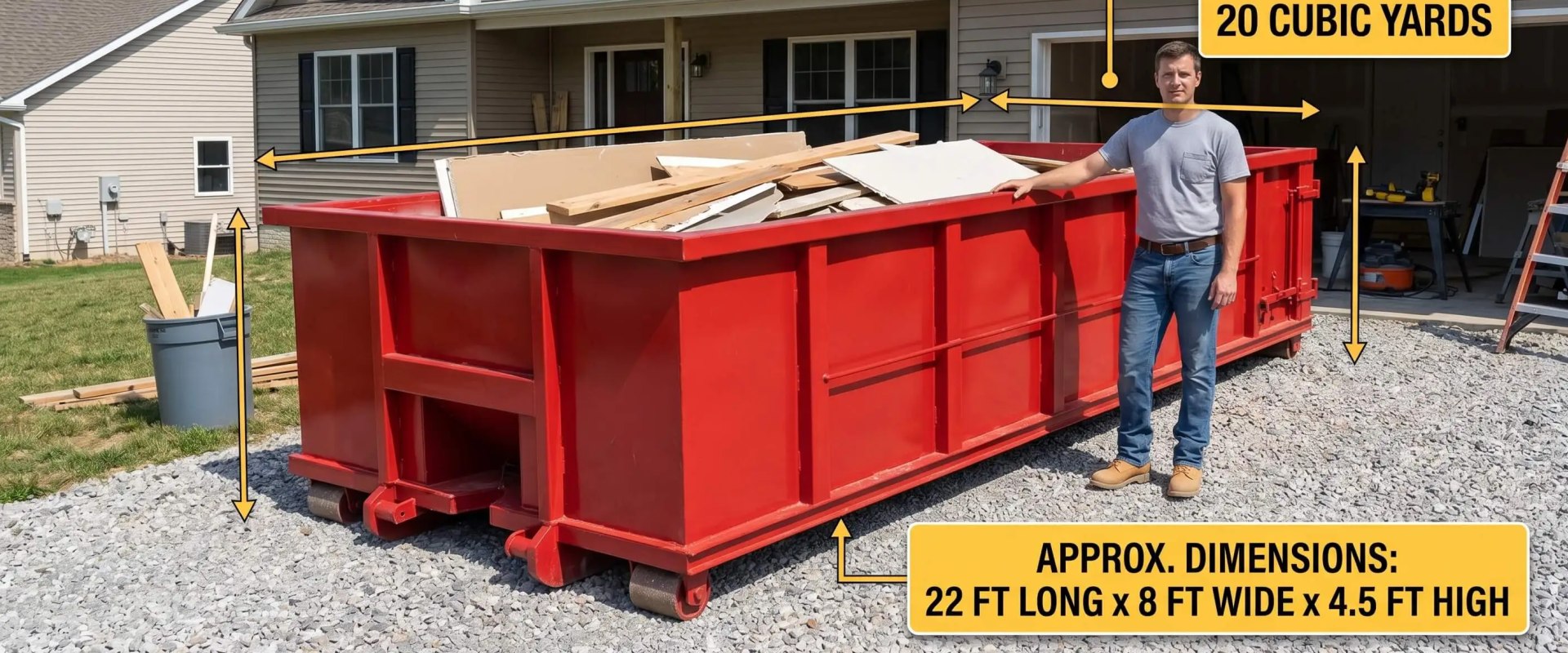
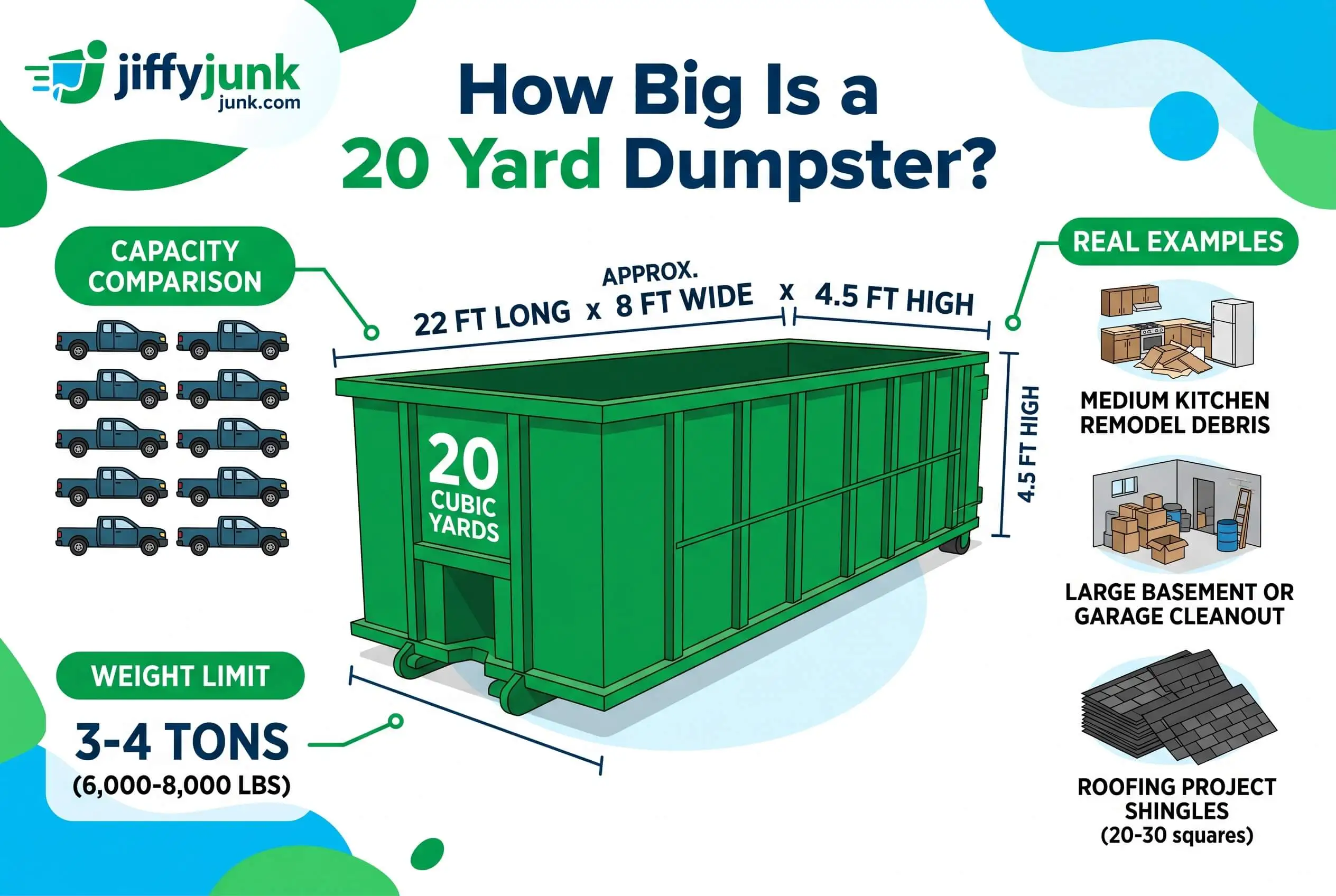
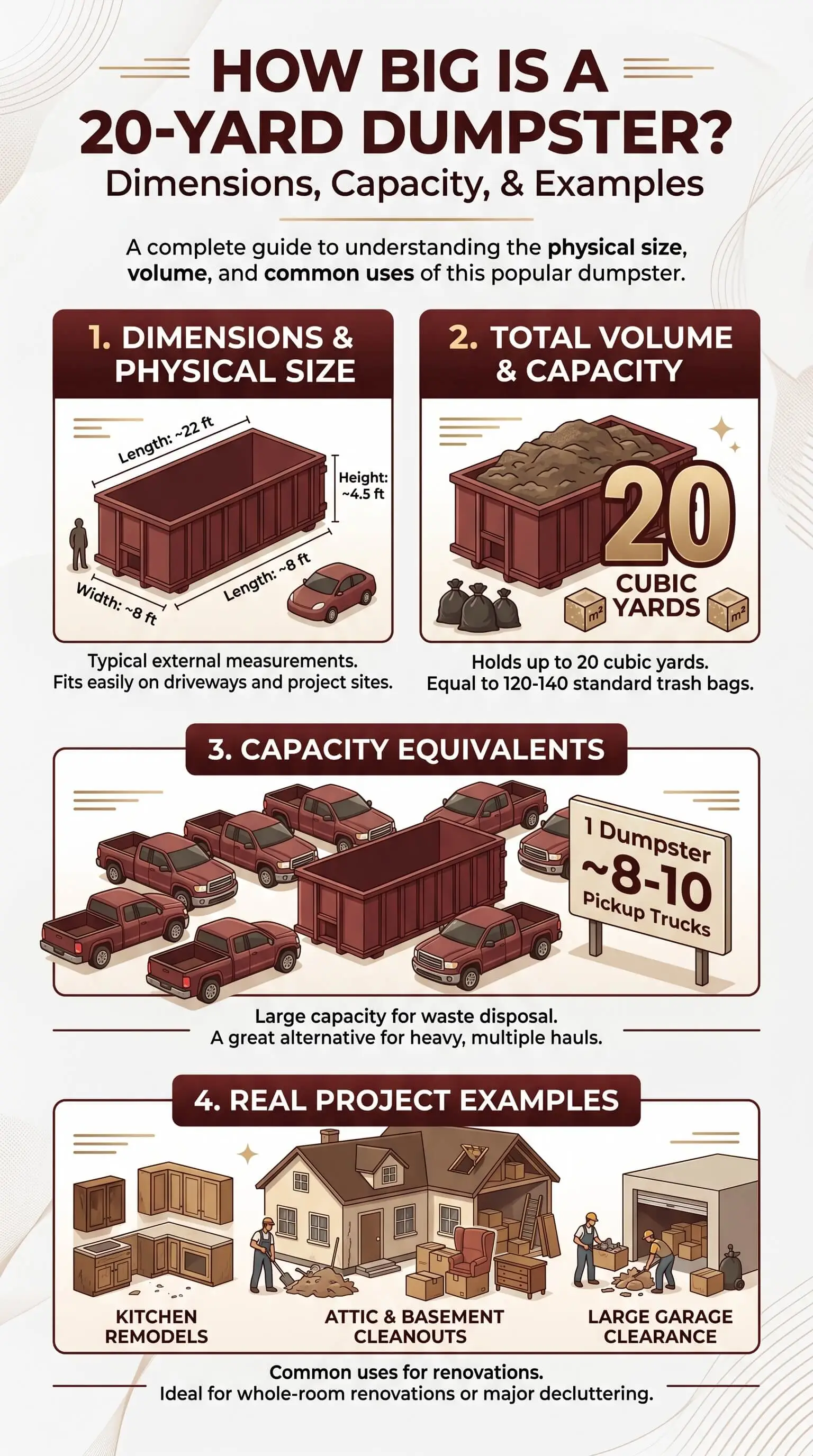
A 20 yard dumpster measures 22 feet long, 8 feet wide, and 4.5 feet tall, and holds 20 cubic yards of debris (about 6 standard pickup truck loads). Most rental companies cap the weight at 2 to 3 tons.
Dimensions: 22 ft × 8 ft × 4.5 ft
Volume: 20 cubic yards
Capacity equivalent: ~6 pickup truck loads or 110–130 standard 33-gallon trash bags
Weight limit: 2–3 tons (4,000–6,000 lbs)
Best for: Kitchen remodels, mid-size roof tear-offs, two-car garage cleanouts
The size most homeowners get wrong: weight, not volume, drives overage fees. Heavy materials like tile, concrete, brick, and cast iron hit the 2-to-3-ton ceiling before you've filled half the container, so size up by weight when your demo is dense.
Top Takeaways
A 20 yard dumpster typically measures 22 ft × 8 ft × 4.5 ft and holds 20 cubic yards of debris.
Capacity equates to roughly 6 standard pickup truck loads or 110–130 standard 33-gallon trash bags.
Standard included weight limit runs 2 to 3 tons (4,000–6,000 lbs), with overage fees of $50 to $100 per additional ton.
It's the most popular size for mid-sized residential renovations, including single-room kitchen remodels, roof tear-offs under 2,500 sq ft, and full garage cleanouts.
For projects with heavy demolition (tile, concrete, brick, cast iron), size up by weight, not just volume.
Plan for 22 ft of length, 10 ft of width, and 23 ft of overhead clearance for safe driveway placement.
Street placement may require a municipal permit. Confirm before booking.
Separating recyclables before disposal can meaningfully reduce tipping fees and overage charges.
Standard 20 Yard Dumpster Dimensions
"20 yard" refers to volume, not length. That single distinction trips up first-time renters more often than any other detail in the rental process. Most providers' 20 yard roll-off containers fall within this range:
Length: 20–22 feet
Width: 7.5–8 feet
Height: 4–4.5 feet
Volume capacity: 20 cubic yards
Weight limit: 2–3 tons (4,000–6,000 lbs)
Pickup truck equivalent: ~6 standard pickup beds
The word dumpster itself started as a Dempster brand product in the 1930s — Dempster-Dumpster — and has been the generic term for these roll-off containers ever since.
What Fits Inside a 20 Yard Dumpster
Cubic yards mean nothing until you can picture them, and that's where most online sizing guides fall short. Here's what 20 cubic yards actually looks like for the projects you're probably planning:
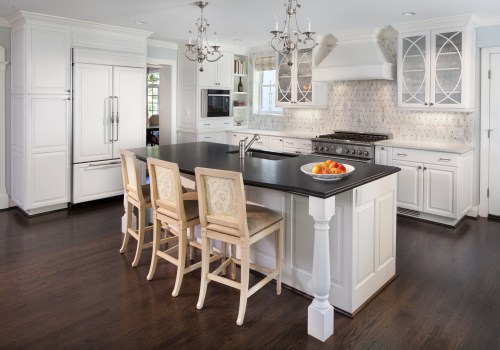
Kitchen remodel: Full tear-out of cabinetry, countertops, flooring, and drywall for a 150–250 sq ft kitchen
Bathroom remodel: Two full bathroom renovations, or one large primary bath with extensive tile demo
Roofing: Up to ~2,500 sq ft of single-layer asphalt shingles (watch the weight limit closely)
Flooring removal: Tear-out across a 1,500–2,000 sq ft home
Garage or basement cleanout: Complete clear-out of a two-car garage
Estate cleanout: Mid-size single-family home contents
Yard waste & landscaping: Large-scale tree removal, sod replacement, or landscape demolition
20 Yard vs. Other Common Sizes
10 yard: 12–14 ft long, 10 cubic yards, 3 pickup loads. Best for bathroom remodels and small cleanouts.
20 yard: 20–22 ft long, 20 cubic yards, 6 pickup loads. Best for kitchen remodels and mid-size projects.
30 yard: 22 ft long, 30 cubic yards, 9 pickup loads. Best for whole-home renovations and large additions.
40 yard: 22 ft long, 40 cubic yards, 12 pickup loads. Best for new construction and full demolitions.
For homeowners who want a deeper look at how 20 cubic yard dimensions translate into rental cost and regional pricing, JiffyJunk has published a detailed guide on 20 cubic yard dumpster size, dimensions, and rental cost that pairs well with the dimensional information here.
Weight Limits — The Detail Most People Get Wrong
Volume capacity and weight capacity are two separate ceilings on the same rental, and you can hit one long before the other. Heavy materials hit the scale first: concrete, brick, tile, dirt, asphalt shingles in volume. Most providers cap a 20 yard at 2 to 3 tons in the base price. Overage fees typically run $50 to $100 per additional ton.
Placement Requirements
Plan for a flat clearance zone around 22 feet long and 10 feet wide (you'll want a couple of extra feet on each side for the truck's roll-off mechanism), plus 23 feet of overhead clearance for the delivery process. Most standard residential driveways accommodate a 20 yard. If you're placing on the street, check with your municipality before booking. Many cities require a temporary placement permit.
"After years coordinating dumpster deliveries for kitchen and home renovation projects, I've learned the 20 yard sits in a strange sweet spot: big enough that homeowners assume they'll have plenty of room, light enough on tonnage that they often don't. On a recent kitchen remodel I helped plan in Southern California, we filled a 20 yard barely halfway by volume. The cast iron tub and tile demolition pushed us 800 pounds over the weight limit anyway. The average was $87. The lesson I now share with every client: when you're tearing out anything dense — tile, stone, masonry, old plumbing — size your dumpster by weight, not volume. It's the single most expensive misconception in the rental process, and the kind you only learn the hard way once."
7 Essential Resources
For deeper research on dumpster sizing, construction debris, and renovation planning, these are the sources I rely on most:
EPA – Construction and Demolition Debris: Material-Specific Data — Official U.S. government data on C&D waste generation, composition, and recycling rates: https://www.epa.gov/facts-and-figures-about-materials-waste-and-recycling/construction-and-demolition-debris-material
EPA – Sustainable Management of Construction and Demolition Materials — National guidance on managing renovation and demolition debris responsibly: https://www.epa.gov/smm/sustainable-management-construction-and-demolition-materials
Wikipedia – Dumpster (overview and history) — Background on the dumpster, its origin as a Dempster brand product, and the broader category of roll-off containers: https://en.wikipedia.org/wiki/Dumpster
Joint Center for Housing Studies of Harvard University – Leading Indicator of Remodeling Activity (LIRA) — Quarterly outlook on national home improvement and repair spending: https://www.jchs.harvard.edu/research-areas/remodeling/lira
JiffyJunk – How Big Is a 20 Cubic Yard Dumpster? Size, Dimensions, and Rental Cost — Detailed breakdown of 20 cubic yard dumpster pricing, dimensional variations, and rental logistics: https://www.jiffyjunk.com/blog/how-big-is-a-20-cubic-yard-dumpster-size-dimensions-and-rental-cost/
NAHB – Drivers of Remodeling Spending — National Association of Home Builders research on the U.S. remodeling industry: https://www.nahb.org/nahb-community/councils/remodelers/drivers-of-remodeling-spending
Kitchen Remodeling 101 – Dumpster Rental Checklist Before Your Project Starts — A practical pre-rental checklist I send clients before they book: https://www.kitchenremodeling101.net/dumpster-rental-checklist-before-your-project-starts
3 Statistics
1. Americans generated 600 million tons of construction and demolition debris in 2018, more than twice the volume of municipal solid waste. That scale is exactly why proper sizing on residential rentals matters. Pick too small and you pay for a second haul. Pick too large and you pay for empty space. Source: U.S. Environmental Protection Agency — https://www.epa.gov/facts-and-figures-about-materials-waste-and-recycling/construction-and-demolition-debris-material
2. U.S. homeowner remodeling spending is projected to reach $524 billion in early 2026, a record high. Demand for properly sized debris removal has scaled directly alongside this growth, and the 20 yard remains the workhorse for most mid-sized renovations. Source: Joint Center for Housing Studies of Harvard University, October 2025 LIRA — https://www.jchs.harvard.edu/blog/remodeling-expected-continue-slow-steady-growth-next-year
3. Approximately 76% of all U.S. construction and demolition waste was recovered or recycled in 2018, with concrete and asphalt concrete recovery rates above 95%. When you load a 20 yard, separating heavy recyclables (clean concrete, metal) from mixed debris can cut your tipping fees and prevent overage charges. Source: U.S. Environmental Protection Agency — https://www.epa.gov/smm/sustainable-management-construction-and-demolition-materials
Final Thoughts and Opinion
Years of planning these orders has taught me one consistent lesson rental company websites won't share: whether the 20 yard fits your project depends almost entirely on weight, not the cubic yard count most homeowners use to make the decision.
For a typical kitchen remodel — cabinetry, lightweight countertops, drywall, vinyl or laminate flooring — the 20 yard is close to perfect. You'll fill 70 to 85 percent of the volume and stay comfortably under the weight limit. The math changes the moment you add cast iron, ceramic tile in volume, granite, brick, concrete, or asphalt shingles to the load. I've watched homeowners pay $200 in overage fees on a single rental because they assumed they could keep filling until the rim was level, only to learn the included tonnage maxed out at half capacity.
My recommendation: size your decision around the heaviest category of debris you'll generate, especially when planning long term roll off rentals that give homeowners more flexibility across multi-phase projects. If you're working with mostly lightweight materials, the 20 yard works well. If even one room involves heavy demolition, size up to a 30 yard with a higher tonnage allowance, or order two smaller 10 yards staggered by week so you don't pay overage fees on a single overloaded container. The planning takes ten minutes and quietly saves homeowners hundreds of dollars.
Frequently Asked Questions
How big is a 20 yard dumpster in feet? A 20 yard dumpster typically runs 20 to 22 feet long, 7.5 to 8 feet wide, and 4 to 4.5 feet tall. It holds 20 cubic yards of debris by volume.
How many tons can a 20 yard dumpster hold? Most providers include a 2 to 3 ton (4,000–6,000 lb) weight limit on a 20 yard rental. Heavier loads incur overage fees, usually $50 to $100 per ton above the included allowance.
How many pickup truck loads fit in a 20 yard dumpster? A 20 yard dumpster holds about 6 standard full-size pickup truck bed loads of debris.
Will a 20 yard dumpster fit in my driveway? In most cases, yes. You'll need around 22 feet of clear length, 10 feet of width including roll-off clearance, and 23 feet of overhead clearance for the delivery truck.
What's the difference between a 20 yard and 30 yard dumpster? A 30 yard holds 50% more volume than a 20 yard with similar length but taller walls (typically 6 ft vs. 4.5 ft). Its included weight limit also runs higher: 4 to 5 tons compared to 2 to 3.
Is a 20 yard dumpster big enough for a kitchen remodel? For most single-room kitchen remodels of 150 to 250 sq ft, yes. Full-gut renovations, kitchen-plus-dining tear-outs, or projects involving heavy tile, stone countertops, or cast iron plumbing usually need a 30 yard.
Ready to Choose the Right Dumpster for Your Project?
You've got the dimensions, the capacity, and the weight rules. The next step before delivery day is running through a final pre-rental check. My Dumpster Rental Checklist Before Your Project Starts covers placement, permits, prohibited items, and weight allowances in one short list.
Have you rented a 20 yard dumpster recently? Tell me what project you used it for in the comments. The more real examples we collect, the more useful this guide becomes for the next homeowner standing in a half-demolished kitchen wondering what size to order.