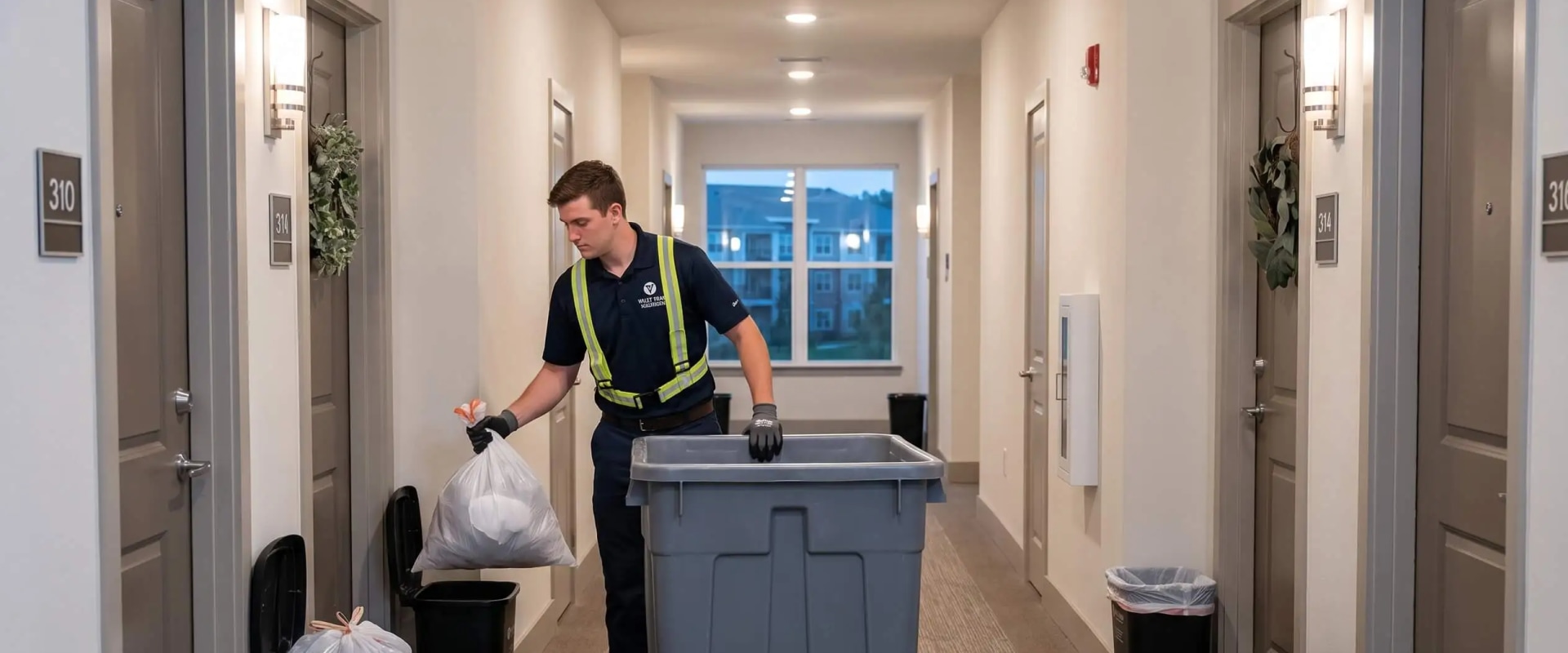
That window between when residents put trash out and when the crew picks it up is where clean hallways are won or lost. Not in the lease. Not in the vendor contract. In those few hours.
Valet trash service is a doorstep waste pickup program. A contracted crew collects bagged trash from apartment doors on a set schedule, typically five nights a week between 8 PM and 11 PM. Done well, it’s the most-touched amenity on most properties, and one of the strongest tools a building has for keeping shared corridors clean and pest-free. Done poorly, it’s a complaint generator.
This guide lays out the actual practices that work, broken out for residents, property managers, and owners. No fluff. No vendor pitch. What we’ve seen produce clean hallways, and what we’ve seen create problems.
TL;DR Quick Answers
valet trash pickup service
A valet trash pickup service is a doorstep waste collection program at apartment communities, condominiums, student housing, and senior living properties. A uniformed crew collects tied bags from outside resident doors during a set evening window, typically 8 PM to 11 PM, five nights per week (Sunday through Thursday).
Standard pricing runs $8 to $15 per unit per month at the property level, and $25 to $35 per month at the resident level. The fee is usually built into rent or HOA dues, not billed separately.
The single thing that separates a good valet trash pickup service from a bad one is pickup-window discipline. Vendors who hit the published window every single night produce clean hallways. Vendors who miss two pickups a month produce pest issues, odor complaints, and the negative online reviews that follow. Price comparison won't tell you which is which. Audit a vendor's actual on-time rate before signing.
Top Takeaways
Valet trash pickup service is a doorstep waste collection amenity where a contracted crew collects tied bags from unit doors on a set schedule, typically 8 PM to 11 PM, five nights per week.
Hallway cleanliness is a system problem, not a tenant problem. Weak rules, mismatched bins, and unreliable vendors cause far more issues than careless residents do.
Residents should use only the designated bin, double-bag tightly, set out only during the pickup window, and never include prohibited items.
Property managers should put rules in the lease, standardize bins, audit the vendor’s pickup schedule weekly, and document violations through a clear workflow.
Vendor selection matters more than vendor price. Pickup-window discipline is the single strongest predictor of clean hallways.
Pricing benchmarks: $8 to $15 per unit per month at the property level, up to $35 per month at the resident level. Outliers in either direction warrant questions.
Pest issues, odor complaints, and review damage almost always trace back to bins set out early or pickups missed. Both are fixable through rules and audits, not new vendors.
What Is a Valet Trash Pickup Service?
A valet trash pickup service is a contracted, doorstep waste collection program offered as an amenity in apartment communities, condominiums, student housing, and senior living properties. Residents place tied bags of household trash inside a bin outside their unit door during a published pickup window. A uniformed crew, sometimes called porters or valets, collects the bags route-by-route and brings them to the property’s onsite dumpster or compactor. Some programs include curbside recycling collection on designated nights as well.
The term itself borrows from the traditional definition of a valet, a personal attendant who handles routine tasks on someone else’s behalf. The naming captures the service’s core promise: residents skip the trip to the dumpster, and a trained crew handles the haul.
Most programs share a few standard features:
Bagged, tied trash only (no loose items, no liquids).
A lidded bin provided by the property or vendor.
Five-night-per-week service, typically Sunday through Thursday.
A 2–3 hour pickup window in the evening, most commonly 8 PM to 11 PM.
A bundled fee built into rent or HOA dues, not billed separately.
The fee structure surprises most new residents: valet trash isn’t optional in most lease agreements. If your lease references it, you’re paying for it whether you set the bin out or not.
Why Hallway Cleanliness Comes Down to the System, Not the Tenant
Most “messy hallway” complaints get blamed on residents, and most of the time that diagnosis is wrong. Residents follow the path of least friction. When the rules are clear, the bins are standardized, and pickup happens on schedule, hallways stay clean almost without effort. When any of those break, even careful residents start cutting corners.
We’ve watched properties go from weekly pest treatments and a stack of online complaints to clean hallways and resident appreciation posts in under sixty days. The change wasn’t a stricter enforcement letter. It was tightening up three things: the written rules, the bin standard, and the vendor’s pickup-window discipline. That’s the system.
The cost of getting it wrong runs higher than most owners realize. Hallway odors and pest sightings drive negative online reviews, which suppress lease conversions. Residents who renew at lower rates because they’re tired of dragging trash through a dirty corridor cost the property more than a tighter rules document or a better vendor would. For managers, every overflowing bin in front of a unit becomes a maintenance call, a violation letter, or both.
It’s worth understanding how a lease clause about valet trash service is typically written before you try to enforce it. Many properties find their hands tied by language they didn’t draft carefully.
Valet Trash Best Practices for Residents
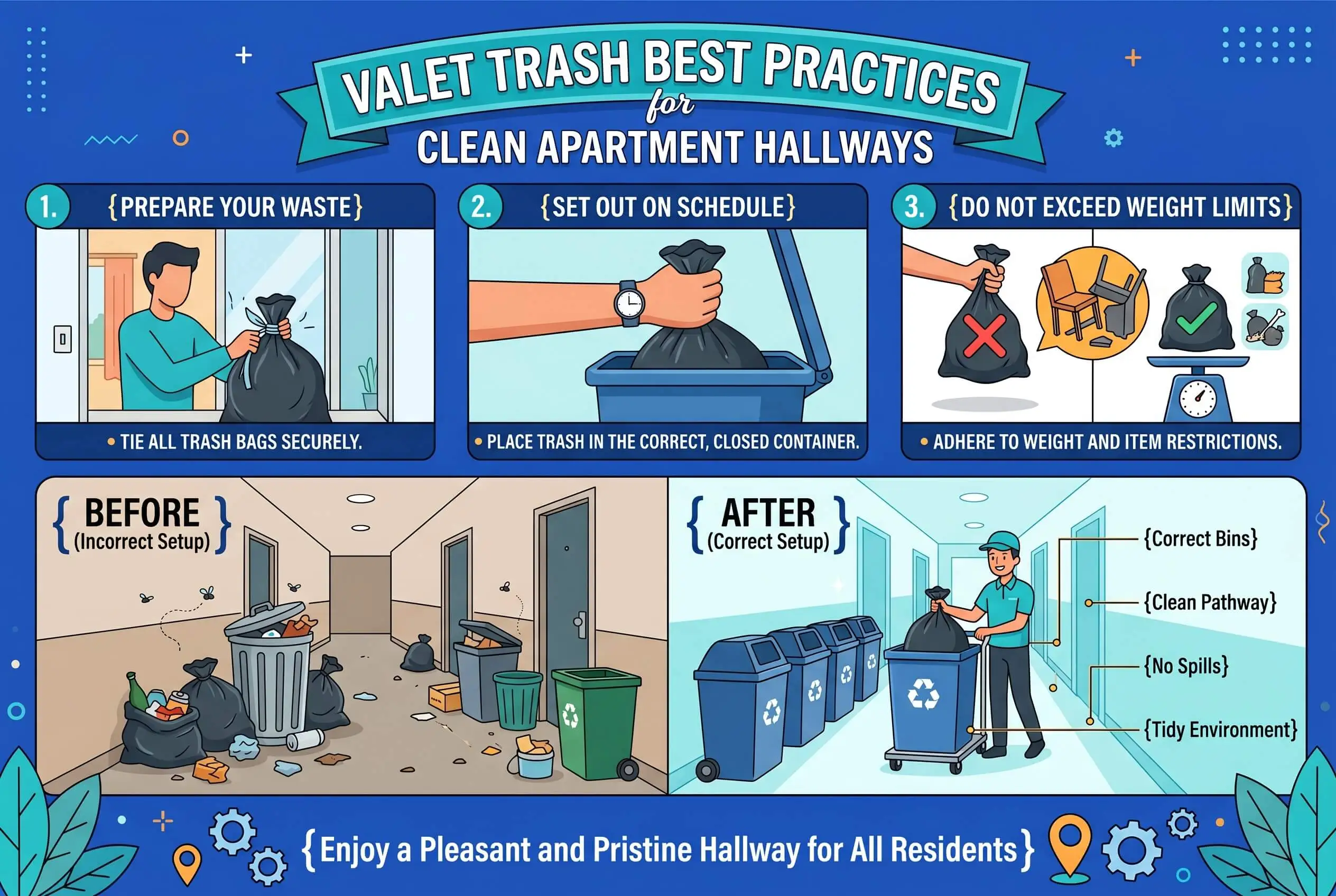
The five rules below handle roughly 90% of the resident-side complaints we see. None require special equipment, and all of them work.
1. Use Only the Designated Bin (No Loose Bags)
The bin matters more than residents realize. Loose bags get clawed open by pests within minutes, and a closed lid keeps odors contained between when you set the bin out and when the crew arrives. If your property issued you a bin, use it. If they didn’t, ask.
2. Double-Bag and Tie Off Tightly
A single thin kitchen bag is the number-one cause of hallway leaks we see. Use heavier-mil bags for anything wet, and double-bag if you’re disposing of leftovers, coffee grounds, or anything else with moisture. Knot the bag instead of using a twist tie. Twist ties slip during transport.
3. Set Out Only During the Published Pickup Window
If your pickup window starts at 8 PM, the bin goes out at 8 PM, not at noon. Bins set out early are the single biggest source of pest issues, because they sit unattended in a temperature-controlled corridor for hours. Most leases give the property the right to fine residents for early or late placement. The rules exist for a reason.
4. Keep Recycling and Trash Separate
If your property runs a recycling night, follow the published material list. Contaminated recycling gets rejected at the facility, charged back to the property, and quietly drives up the fees built into your rent. Separate the streams.
5. Never Use Valet Trash for Prohibited Items
Most programs prohibit several categories of waste: hazardous materials (paint, batteries, chemicals), bulk items (furniture, mattresses), unbroken large boxes, glass that could shatter, and any waste outside a single tied bag. When in doubt, check your lease addendum or the door-hanger your vendor leaves at move-in.
Valet Trash Best Practices for Property Managers
The manager-side fixes are where the biggest gains live. Four practices worth tightening this quarter:
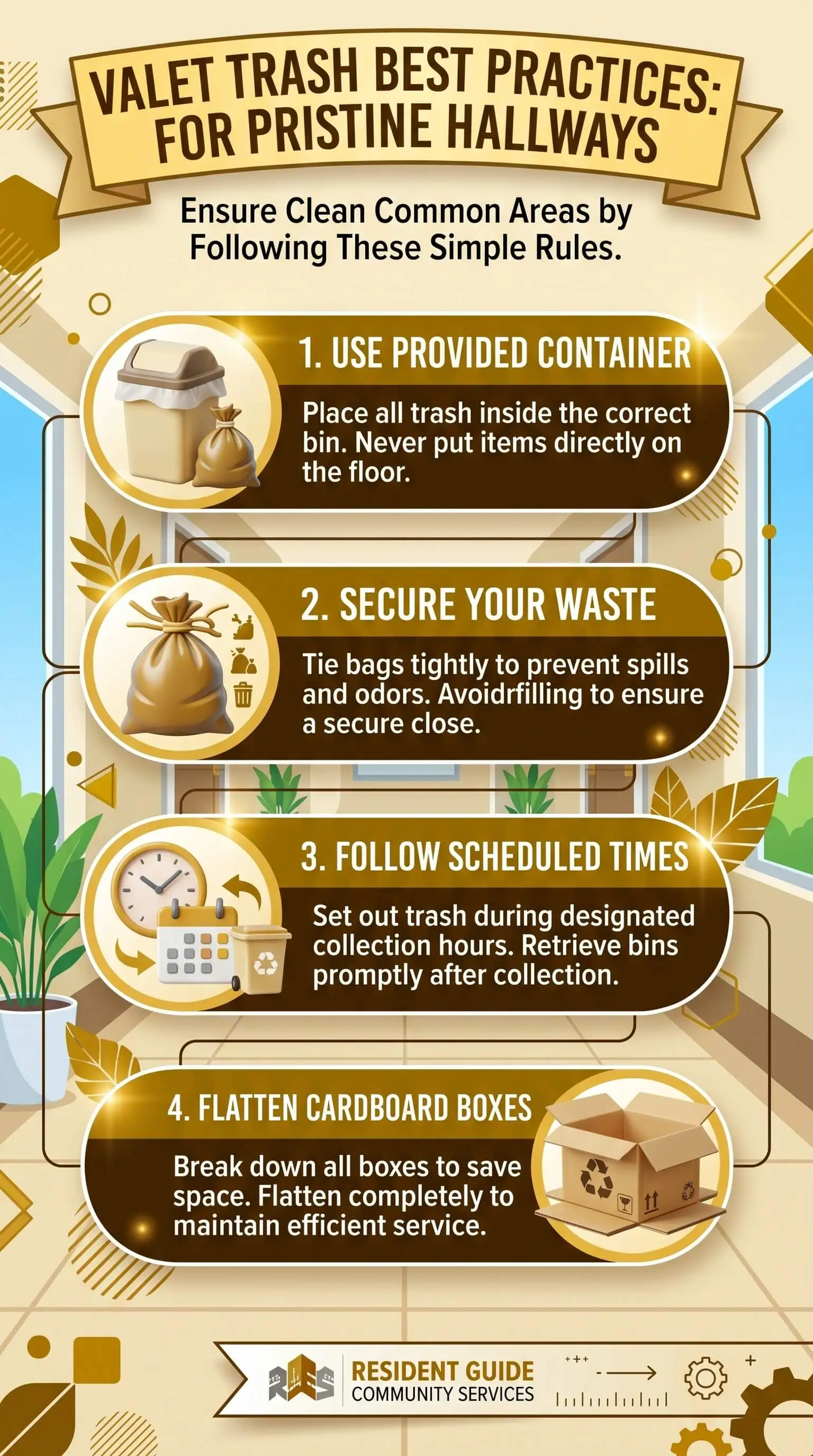
Set Written Rules and Put Them in the Lease
Verbal rules don’t enforce. The pickup window, accepted items, prohibited items, and violation policy should all live in the lease addendum. Make it 1–2 pages, plain language, and signed.
Standardize the Bin
Mismatched bins create visual chaos in a hallway. Every bin should be the same size, the same color, and the same lidded design. If your vendor doesn’t supply uniform bins, that’s a vendor question worth asking on your next contract review.
Audit the Pickup Schedule
Vendors miss pickups. The question is whether you find out from a resident complaint or from your own audit. Walk the property the morning after pickup at least once a week. Document missed bins. Report them to the vendor with photos and timestamps. Vendors who know they’re being audited perform measurably better than those who aren’t.
Build a Violation Workflow
When a resident violates the rules, the property needs a documented sequence: a door hanger, then a written warning, then a fine. Without that workflow, enforcement becomes arbitrary, and arbitrary enforcement creates fair-housing risk.
How to Choose a Valet Trash Pickup Service That Keeps Hallways Clean
Vendor selection is where most properties either set themselves up for clean hallways or quietly book years of complaints. Six criteria we’d put any vendor through:
Uniformed, background-checked porters. Anonymous crews lead to anonymous accountability.
Consistent pickup window, published rather than estimated. “We start sometime in the evening” is a red flag.
Documented route auditing. GPS-verified or photo-verified pickup logs separate professional vendors from informal ones.
Missed-pickup recovery time of 24 hours or less. A skipped night that runs 48 hours becomes a pest issue.
Transparent per-unit pricing. No surprise add-ons for recycling, holidays, or bulk nights.
Contract flexibility. Multi-year exclusivity contracts can lock you in with a vendor whose performance has declined.
Pricing varies by market and route density, so before committing it’s worth comparing what a professional valet trash pickup service typically costs for apartments and homes. The right vendor pays for itself in reduced maintenance hours and resident retention. The wrong one costs more than the line item suggests.
Common Hallway Cleanliness Issues, and How to Fix Them
Most problems trace back to the same handful of causes. Diagnosis below:
Lingering odors trace back to improper bagging. Fix: require double-bagged, knotted liners.
Pests in the hallway are almost always triggered by bins set out too early. Fix: enforce strict pickup-window timing.
Bins left out next morning mean the vendor missed pickup. Fix: audit driver logs and require missed-pickup re-runs.
Broken or leaking bags come from single thin bags. Fix: recommend heavier-mil bags for wet kitchen waste.
Recycling contamination comes from unclear stream rules. Fix: use door-hanger reminders and post-pickup feedback.
Fix the cause, not the symptom. Five hallway problems, five operational levers, each one inside the property’s control, helping communities stay cleaner and more organized even when residents are improving their homes with a kitchen remodel.
“I’ve walked first-floor hallways where the only difference between ‘clean’ and ‘pest control on speed dial’ was twenty minutes of timing. Same residents. Same building. Same bins. The properties with clean hallways had a vendor who hit their pickup window every single night, and rules residents could actually understand. The struggling ones had neither. After more than a decade looking at multifamily operations, I’ve come to think of valet trash less as a sanitation contract and more as a daily test of whether the property’s systems work. Every resident sees the result of that test, every morning, on the way to their car.”
7 Essential Resources
For property managers, owners, and residents who want to dig deeper into the standards and data behind clean-corridor practices, these seven resources are worth bookmarking. All links verified at time of publication.
EPA — Facts and Figures about Materials, Waste and Recycling. Annual data on U.S. waste generation, recycling rates, and disposal trends. The baseline reference for understanding the volume your property handles. https://www.epa.gov/facts-and-figures-about-materials-waste-and-recycling
EPA — State and Local Waste and Materials Characterization Reports. State-level breakdowns of what’s in the waste stream, useful for benchmarking your property’s recycling program against regional norms. https://www.epa.gov/facts-and-figures-about-materials-waste-and-recycling/us-state-and-local-waste-and-materials
CDC — Controlling Wild Rodent Infestations. Federal guidance on prevention, sanitation, and exclusion. Required reading for any property manager handling pest complaints tied to waste. https://www.cdc.gov/healthy-pets/rodent-control/index.html
CDC — How to Clean Up After Rodents. Step-by-step sanitation protocol for any hallway or trash area where rodent activity has been found. Important reference if your property has had a recent infestation. https://www.cdc.gov/healthy-pets/rodent-control/clean-up.html
National Apartment Association — Winning the Amenities Arms Race. Industry overview of how amenities like valet trash collection have moved from differentiator to baseline expectation. Useful context for owners benchmarking their property. https://www.naahq.org/news/winning-amenities-arms-race
University of Michigan Center for Sustainable Systems — Municipal Solid Waste Factsheet. Concise, data-rich overview of how much waste Americans generate and where it ends up. Updated annually. https://css.umich.edu/publications/factsheets/material-resources/municipal-solid-waste-factsheet
Wikipedia — Valet. Background on the etymology and historical role of the valet, useful context for understanding the term’s adoption in the waste industry. https://en.wikipedia.org/wiki/Valet
3 Statistics
Three numbers, drawn from primary sources, that frame how a property should think about valet trash service.
4.9 pounds of waste per person, per day. Across roughly 292 million tons of municipal solid waste annually, residential waste, including waste from apartments, accounts for the largest share. Multifamily properties don’t move a small stream. They move a measurable percentage of the national total. (Source: U.S. EPA, Advancing Sustainable Materials Management: Facts and Figures — https://www.epa.gov/facts-and-figures-about-materials-waste-and-recycling/advancing-sustainable-materials-management)
Every 37 days, the average American generates their own body weight in waste. Translated to a 200-unit property at average occupancy, that’s tens of thousands of pounds of waste passing through a single building every month. The valet trash pickup service handling that volume isn’t a luxury. It’s an operational necessity. (Source: University of Michigan Center for Sustainable Systems, Municipal Solid Waste Factsheet, 2025 — https://css.umich.edu/publications/factsheets/material-resources/municipal-solid-waste-factsheet)
Industry-standard pickup runs 8 PM to 11 PM, five nights per week, typically Sunday through Thursday. For property managers, the per-unit cost generally lands between $8 and $15 per month, with resident-facing fees running up to $35 per month depending on market, frequency, and contract length. Properties pricing or scheduling outside these benchmarks should ask their vendor why. (Source: Property Manager Insider — https://propertymanagerinsider.com/how-much-does-valet-trash-service-cost/)
Final Thoughts and Opinion
Valet trash service either delivers daily or quietly damages the property daily. There’s no middle ground. A pool that’s closed for a week is a complaint. A valet trash pickup service that misses two pickups a month is something worse: a slow erosion of resident trust, online reputation, and net operating income at the same time. It’s also the most visible amenity on the property. Every resident touches it, every night.
Our take, after watching dozens of properties cycle vendors: managers buy on price more than they should, and on day-to-day reliability less than they should. A vendor that’s fifteen percent cheaper but misses one pickup per week will cost the property more in maintenance hours, complaint letters, and non-renewals than the savings ever recoup. Pickup-window discipline is the single best predictor of clean hallways — buy on that.
For residents, the practical message is shorter: the rules exist because the system breaks fast when they’re not followed. Bag tightly, set out on time, use the bin you were given. The corridor you walk through every morning is the result.
If you’re managing or living in a multifamily property and your hallways aren’t where they should be, the fix usually doesn’t require a new vendor or a new policy. It usually requires the rules and schedule you already have — actually held to, every night.
Frequently Asked Questions
What is a valet trash pickup service?
A valet trash pickup service is a doorstep waste collection program offered as an amenity at apartment communities, condominiums, student housing, and senior living properties. A uniformed crew collects tied bags of household trash from outside resident doors during a set evening window, typically five nights per week.
What time does valet trash pickup happen?
Industry-standard pickup runs between 8 PM and 11 PM, five nights per week, normally Sunday through Thursday. Some properties extend service for student housing or holiday weekends, but 8 to 11 PM is the most common window.
How much does valet trash pickup service cost?
Property managers typically pay $8 to $15 per unit per month to the vendor. Residents typically see $25 to $35 per month built into rent or HOA dues. Pricing varies based on property size, route density, frequency, and contract length.
What can’t be put out for valet trash?
Most programs prohibit hazardous materials such as paint, batteries, and chemicals, large or bulk items like furniture and mattresses, large boxes that haven’t been broken down, glass that could shatter, and any waste outside a single tied bag. Always check the lease addendum for the property’s specific list.
Is valet trash service mandatory for apartment residents?
In most leases that include valet trash, yes. The fee is typically built into rent or HOA dues and isn’t an opt-in service. Residents pay regardless of whether they set the bin out, which is why it’s worth understanding the lease language before signing.
Why does the hallway smell when valet trash runs?
The most common cause is bins set out before the published pickup window. Bags sit in a corridor for hours, especially in summer, before the crew arrives. The fix is enforcement of the pickup-window rule, not a stronger air freshener.
Do valet trash services pick up recycling?
Many do, though usually on designated nights rather than every pickup. Contaminated recycling, where bagged trash gets mixed in with the recyclables, gets rejected at the facility and charged back to the property, which is why following the recycling stream rules matters.
Call to Action
If you’re a property manager evaluating a valet trash pickup service, or a resident trying to understand what your community should be delivering, the next step is the same: pressure-test your current setup against the practices in this guide. Walk the hallway tomorrow morning, read the lease language, and audit one pickup window this week. The fix is almost always closer than it looks.
If this guide helped, share it with your property’s leasing office or a neighbor who’s asked the same questions. Tap or click here to leave a comment with what’s worked at your community. We read and reply to every one. And if you want the bigger picture of how multifamily waste actually moves, read our companion piece on ongoing junk removal services for a wider view of what professional waste operations look like.