That moment is why a field hygiene kit matters. For three days away from a sink, you need to handle six jobs: clean hands, a body wipe-down, teeth, feet, the latrine, and a backup for when water runs low. Get those right and day three feels a lot like day one.
We built this list for campers, field trainees heading out on an FTX, outdoor crews, and families putting together a go-bag. It works at home too. When a kitchen remodel takes your sink out for a few days, the same kit keeps everyone washing up before dinner.
TL;DR Quick Answers
Field Hygiene Kit
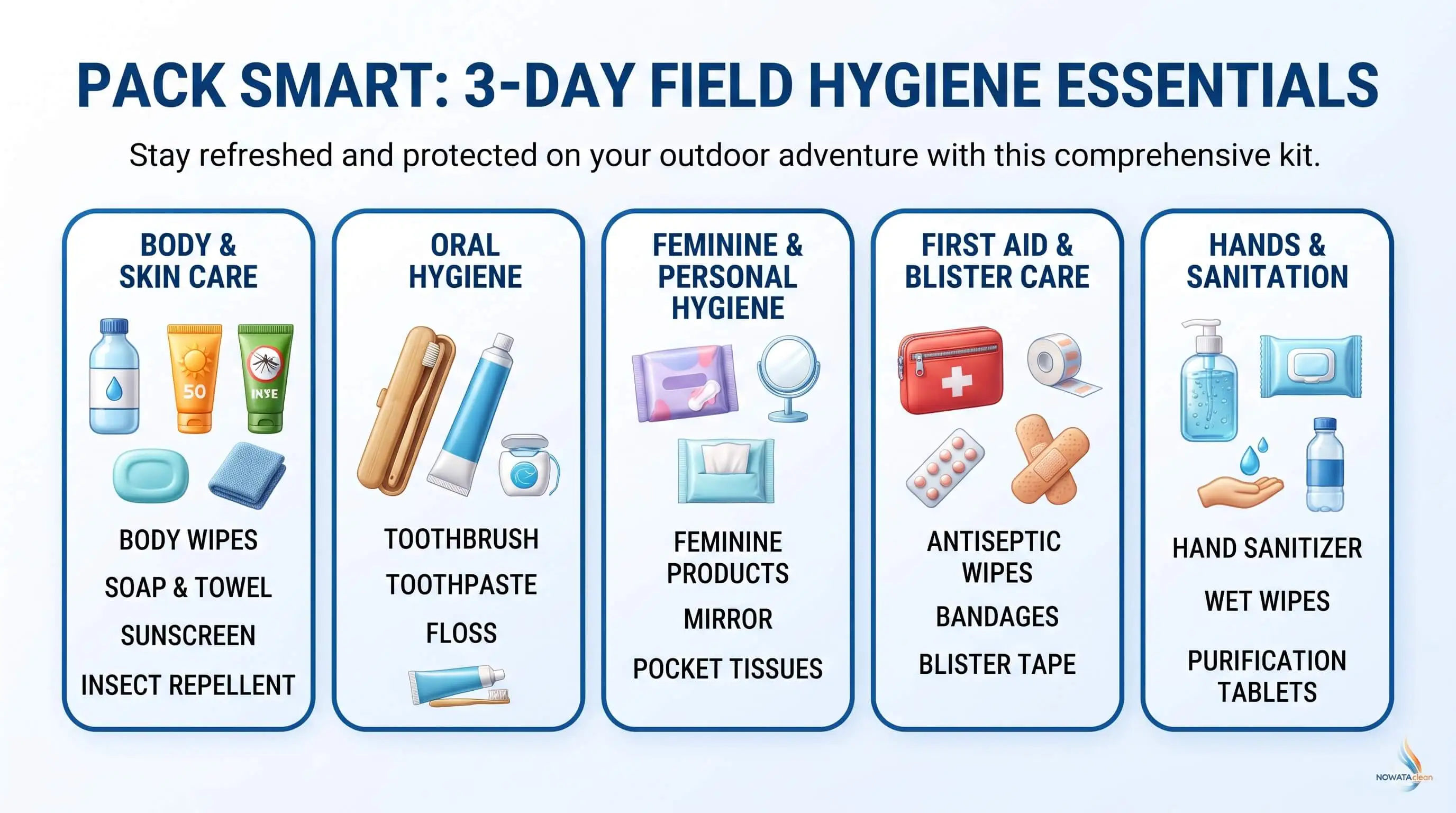
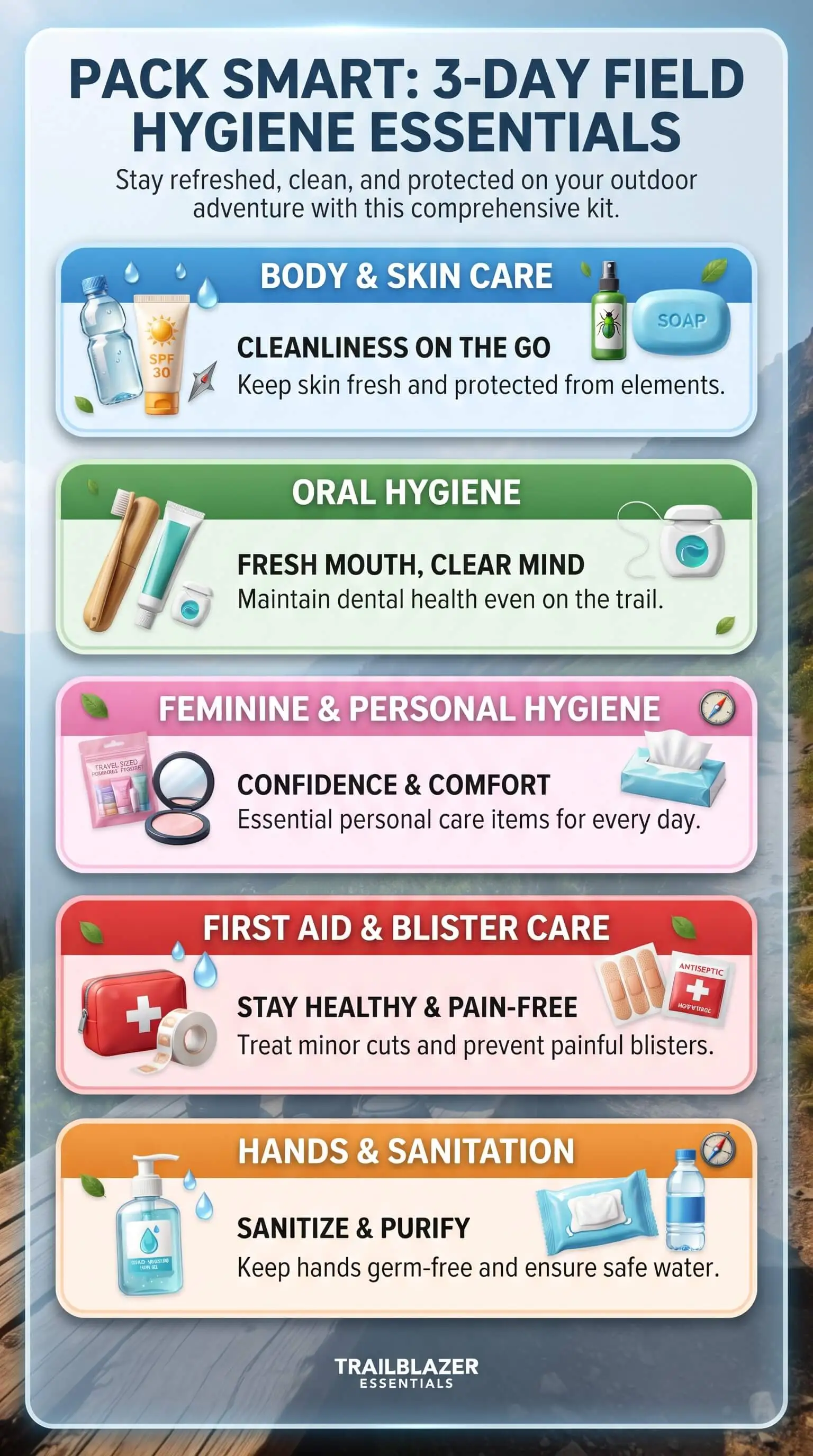
A field hygiene kit is a small personal pouch that keeps you clean when running water is limited or gone. For a 3-day trip, it covers hands, body, teeth, feet, and the latrine, all in one waterproof bag.
Hands: Biodegradable soap, a sanitizer with at least 60% alcohol, and a rinse-free soap for dirty or greasy hands.
Body: 6 to 9 wipes and a quick-dry towel.
Teeth and feet: Toothbrush, travel toothpaste, floss, foot powder, blister patches, and a clean pair of socks for each day.
Latrine: Toilet paper in a zip bag, a small trowel, and sealable bags for packing out waste.
Our take: Plan hand cleaning first. It happens about 8 times a day , and sanitizer won't handle the grimy moments. Soap and clean water come first, and a rinse-free soap covers the gap when water runs short.
Top Takeaways
Your field hygiene kit needs to cover hands, body, teeth, feet, the latrine, and a waterproof bag to keep it all dry.
Plan for about 8 hand cleanings per person per day , or roughly 24 over a 3-day trip.
Soap and clean water come first, and sanitizer is for hands that already look clean.
When your hands are dirty or greasy and water is short, reach for a rinse-free soap.
Pack 6 to 9 body wipes and a clean pair of socks for each day.
Wash and dig catholes at least 200 feet from water, and carry out wipes and menstrual products.
Flying? Keep each liquid at 3.4 ounces or less, all in one quart-size bag.
What Is a Field Hygiene Kit?
It's a small personal pouch that keeps you clean when running water isn't part of the plan.
The idea started with the military. In military medicine, field hygiene and sanitation covers the habits that stop illness from taking soldiers out of action, and personal hygiene sits near the top of that list. A 3-day kit does the same job on a smaller scale, for one person with one bag.
Build Your 3-Day Field Hygiene Kit
Cover each of these groups:
Hand hygiene
Body and face
Oral care
Foot care
Toilet and waste
Hair and skin
Personal items
A waterproof bag to hold it all
Here's what we pack, and how much of it:
Small biodegradable soap (1 travel bar or 2 oz bottle): Soap and clean water still beat everything else on this list.
Hand sanitizer with at least 60% alcohol (1 bottle, 2 oz): Fast cleanup for hands that already look clean.
Rinse-free hand soap (1 tube): Handles dirty or greasy hands when you can't spare the water.
Body wipes (6 to 9, plus a few spares): Your shower stand-in when bathing isn't an option.
Quick-dry towel (1 small microfiber towel): Dries fast and takes up almost no room.
Toothbrush, travel toothpaste, and floss (1 each): Your teeth don't get the weekend off.
Foot powder and blister patches (1 small container, 4 to 6 patches): Dry feet are moving feet.
Clean socks (1 pair per day): A fresh pair every morning cuts moisture and rubbing.
Toilet paper in a zip bag (1 partial roll): The bag keeps it dry until you need it.
Small trowel (1): For digging catholes where they're allowed.
Sealable trash bags (3 to 4): Everything you use, you carry back out.
Dry shampoo, comb, lip balm, sunscreen, and deodorant (travel sizes): Small comforts that make day three easier.
Menstrual products and prescriptions (enough for 3 days, plus extra): There's no corner store on the trail.
Waterproof ditty bag or hanging pouch (1): One dry home for all of it.
Count Your Washes Before You Pack
Plan on about eight hand cleanings per person per day . That covers waking up, every meal, every latrine trip, and bedtime. Over three days, you're looking at roughly 24.
One tube of all natural non toxic hand soap that's rinse-free and rated for 80 to 100 uses covers that easily. Split it with a buddy, or keep the rest for your next trip.
Wipes disappear faster than you'd think. Two or three a day handles a basic wipe-down, so we pack nine and toss in a few extra.
Keep a Simple Daily Routine
Morning: Clean your hands, brush your teeth, and pull on dry socks.
Before meals: Clean your hands every time, snacks included.
After the latrine: Clean your hands right away.
Evening: Wipe down, check your feet, then brush and floss.
Who Gets the Most Out of a Field Hygiene Kit
Field Training and Basic Training
On an FTX, drinking water usually wins over washing water. A small kit lets you stay clean without pouring your canteen over your hands.
Camping and Backpacking Weekends
Every ounce shows up on your shoulders by mile six. Travel sizes and gear that does double duty keep the kit light.
Wildland Fire, Search and Rescue, and Outdoor Work
Soot and grease build up fast on these jobs, and that's exactly the grime hand sanitizer can't handle.
Emergency Go-Bags and Home Remodels
A storm, an outage, or a boil-water notice can shut off your tap. A remodel that pulls out your kitchen sink does the same thing for a week. With a kit ready to go, you skip the trip to the bathroom sink before every meal.
Stay Clean When Water Is Limited
Soap and clean water win every time you have them. Treat everything else, such as Waterless hand soap, as the backup.
Know Where Hand Sanitizer Stops Working
Sanitizer does fine on hands that look clean. The FDA tells people not to use it on hands that are visibly dirty or greasy, and to wash with soap and water instead. After pitching a tent, fixing a stove, or working near a fire, your hands land right in that gap.
Clean Dirty Hands Without Water
That gap is where a rinse-free soap pulls its weight. It lathers like regular soap, lifts dirt and oil off your skin, and wipes away without a rinse. If there's a sink nearby, use the sink. If there isn't, NOWATA's guide to building a field hygiene kit for training, deployment, and fire camp walks through each scenario.
To use a rinse-free soap in the field:
Squeeze a small amount into your palm.
Rub it over the fronts and backs of your hands, between your fingers, and under your nails.
Keep working on it for about 20 seconds.
Wipe off what's left with a cloth or your quick-dry towel.
Pack out any disposable wipes you used.
Pack It Light
Flying to the trailhead? TSA's 3-1-1 rule applies to liquids in your carry-on. Each container can hold up to 3.4 ounces (100 ml), and they all go in one quart-size bag.
A few ways we cut weight:
Pick solids like bar soap, which don't count toward the liquids limit.
Pour liquids into small refillable bottles, such as a 40 ml silicone bottle.
Bring a bandana that doubles as a washcloth.
Pack for three days, not five. Full-size bottles add weight fast.
Leave No Trace With Your Waste and Wash Water
Staying clean shouldn't leave a mess for the next person. Leave No Trace guidance asks you to:
Wash at least 200 feet (about 70 adult steps) from lakes and streams, with only a little biodegradable soap.
Scatter your wash water widely.
Dig catholes 6 to 8 inches deep and at least 200 feet from water, trails, and camp.
Pack out wipes, even the ones labeled biodegradable, along with tampons and pads.
Mistakes We See on Every Trip
Bringing full-size bottles instead of travel sizes
Using sanitizer on hands that are clearly dirty
Ignoring your feet until a blister shows up
Forgetting a bag for packing out waste
Carrying scented products into bear country
Packing for two days and coming up short on day three
"Every short trip I've packed for, hand cleaning slipped first. Day one is easy. By day two the water jugs are low, everyone's hands are black with gear grease and campfire soot, and the sanitizer bottle gets passed around like it solves the problem. Sanitizer was made for hands that already look clean, so it doesn't. Things changed for me once I treated hand cleaning as its own category, counted how many times a day I'd need it, and packed a rinse-free option for the grimy moments. I also quit overpacking. A 3-day kit should fit in one hand, and if yours doesn't, you've packed for a week."
Essential Resources
We read each of these before writing this guide. Start with the CDC if you only open one.
1. CDC: About Handwashing
The CDC lays out when to wash, how long to scrub (at least 20 seconds), and when a sanitizer with at least 60% alcohol makes sense instead.
Source: CDC, About Handwashing
2. CDC: Hand Sanitizer Guidelines and Recommendations
This page explains why sanitizer may not work as well on dirty or greasy hands. Camping and playing outdoors both make its list.
Source: CDC, Hand Sanitizer Guidelines and Recommendations
3. FDA: Safely Using Hand Sanitizer
The FDA puts it plainly. Skip sanitizer on visibly dirty or greasy hands and wash with soap and water instead.
Source: FDA, Safely Using Hand Sanitizer
4. Leave No Trace: Dispose of Waste Properly
How deep to dig a cathole, how far to wash from water, and which hygiene products you need to carry out. Keep this one bookmarked if you camp often.
Source: Leave No Trace, Dispose of Waste Properly
5. National Park Service: How to Maintain Personal Hygiene While Camping
The NPS covers the small stuff that adds up over a weekend: wipes, microfiber towels, dry shampoo, and keeping scented products away from camp.
Source: National Park Service, How to Maintain Personal Hygiene While Camping
6. TSA: Liquids, Aerosols, and Gels Rule
Check this before you fly with your kit. It spells out the 3-1-1 limits for carry-on liquids.
Source: TSA, Liquids, Aerosols, and Gels Rule
7. Ready.gov: Build a Kit
Ready.gov lists the sanitation basics for an emergency kit, from moist towelettes and garbage bags to soap and hand sanitizer.
Source: Ready.gov, Build a Kit
Supporting Statistics
Handwashing education cuts diarrheal illness by 23% to 40%. Our take: That range is the whole case for giving hand cleaning its own section in your kit. Source: CDC, Handwashing Facts
Handwashing education cuts respiratory illnesses, like colds, by 16% to 21% in the general population. Our take: A sniffle on day two makes for a long day three. Source: CDC, Handwashing Facts
The average person uses about 80 to 100 gallons of water a day at home. Our take: Out in the field you might have a gallon or two for everything, so the water you'd spend on handwashing runs out quickly. Source: USGS, How Much Water Do I Use at Home Each Day?
Final Thoughts and Opinion
Our take: most people overpack the shower stuff and underpack hand cleaning. That's backwards, because hand cleaning happens about eight times a day and showers mostly don't happen at all.
So plan your hands first. Use soap and water whenever you can get them, sanitizer when your hands look clean, and a rinse-free soap for the greasy moments in between. Teeth and feet come next, and a bag for whatever you carry out finishes the job.
Keep the whole kit small enough to grab with one hand. That's the version that actually comes with you, whether you're headed to a campsite, an FTX, a blackout, or a week of eating dinner without a kitchen sink.
This guide is general information, not medical advice.
Frequently Asked Questions
Q: What is a field hygiene kit?
A: A field hygiene kit is a small personal pouch that holds what you need to stay clean away from running water. Most include hand soap, sanitizer, body wipes, oral care, foot care, and toilet supplies. The idea comes from military field hygiene and sanitation, scaled down for one person.
Q: What should I pack in a hygiene kit for 3 days?
A: For three days, pack a travel soap, a 2 oz sanitizer, a rinse-free hand soap, 6 to 9 body wipes, a quick-dry towel, a toothbrush, toothpaste, and floss. Add foot powder, blister patches, toilet paper, a trowel, trash bags, and one pair of clean socks per day.
Q: How many wipes do I need for a 3-day trip?
A: Plan on two or three body wipes a day, which comes to six to nine for the trip. Throw in a few spares for the messy days. Carry every used wipe out in a sealable bag, including the ones labeled biodegradable.
Q: Is hand sanitizer enough on a camping trip?
A: Sanitizer works on hands that look clean, but it won't carry you through a whole trip. The FDA says not to use it on visibly dirty or greasy hands. When your hands are grimy and water is short, use a rinse-free soap, and get to soap and water as soon as you can.
Q: How do you clean your hands without water?
A: Grab a rinse-free soap for dirty hands. Work it over your hands for about 20 seconds, then wipe off what's left with a cloth. If your hands already look clean, a sanitizer with at least 60% alcohol does the job. Go back to soap and water the moment you have them.
Q: Can I bring a field hygiene kit on a plane?
A: Yes. Liquids, gels, and creams in your carry-on need to be 3.4 ounces (100 ml) or less, and they all have to fit in one quart-size bag. Bar soap, wipes, and your toothbrush don't count toward that limit, which makes packing a lot easier.
Q: How do I keep my field hygiene kit dry?
A: Keep everything in a waterproof ditty bag or a hanging toiletry pouch, with toilet paper and paper goods in their own zip bag inside. At camp, hang the pouch off the ground so dew and rain can't soak in.
Q: How do I dispose of wash water and waste outdoors?
A: Wash at least 200 feet from lakes and streams and scatter the water widely. Dig catholes 6 to 8 inches deep and at least 200 feet from water, trails, and camp. Wipes, tampons, and pads go out with you in a sealed bag.
Pack Your Kit Before You Need It
The night before a trip is a rough time to hunt for travel bottles. Print this checklist, gather your travel sizes and soap for backpacking and hiking this week, and build your field hygiene kit so it's sitting ready before your next campout or remodel.
What's the one item you never leave home without? Tell us in the comments.